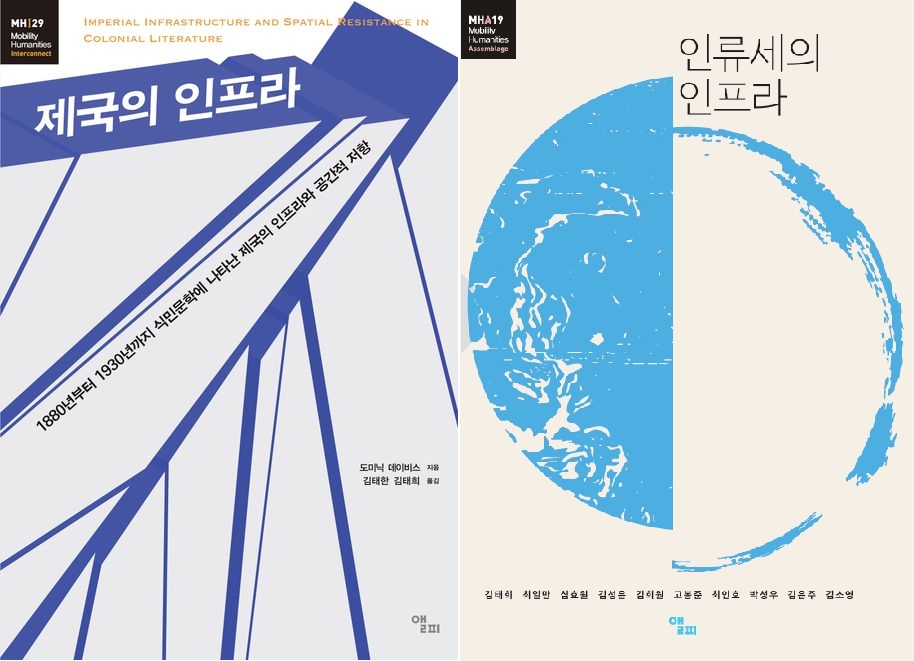
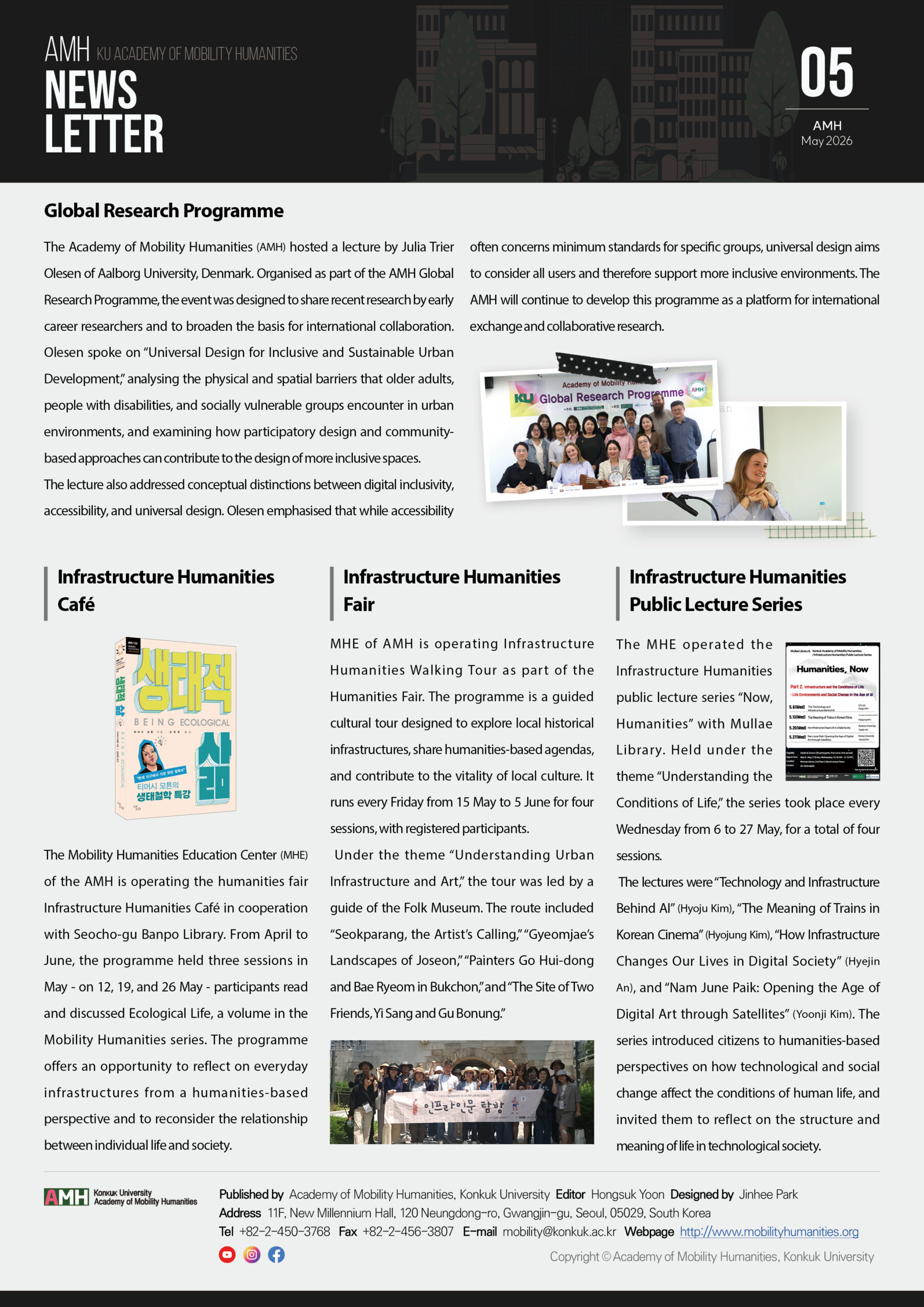
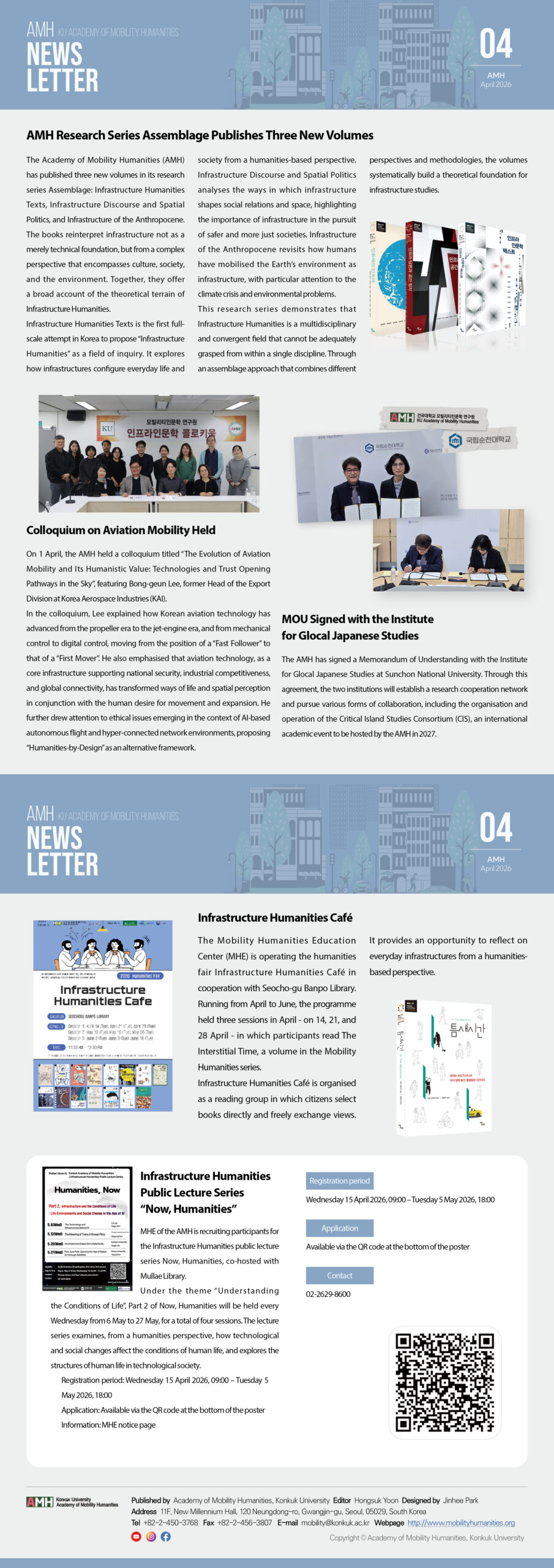
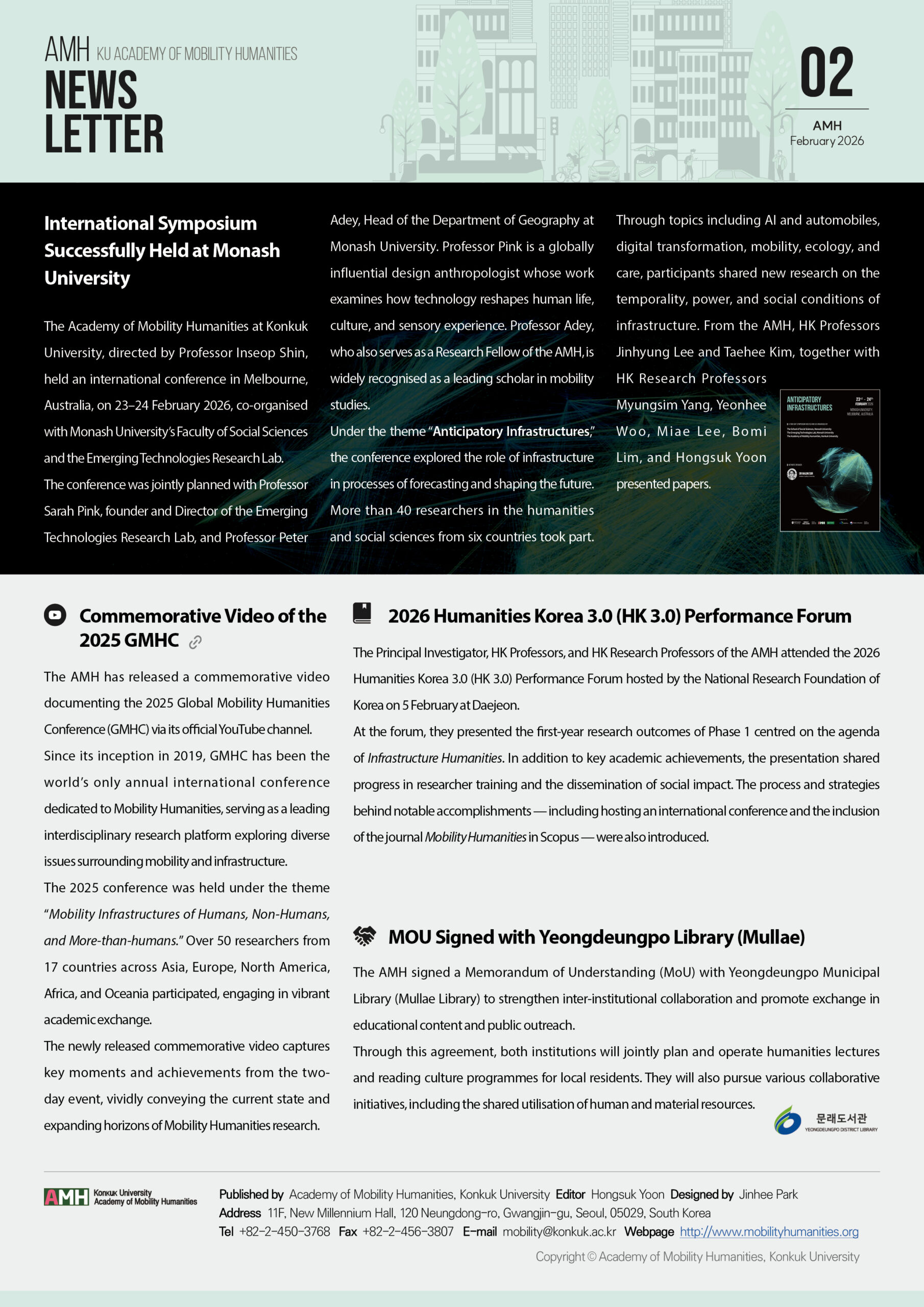
Infrastructures of the Anthropocene and Imperial Infrastructure and Spatial Resistance in Colonial Literature, 1880–1930

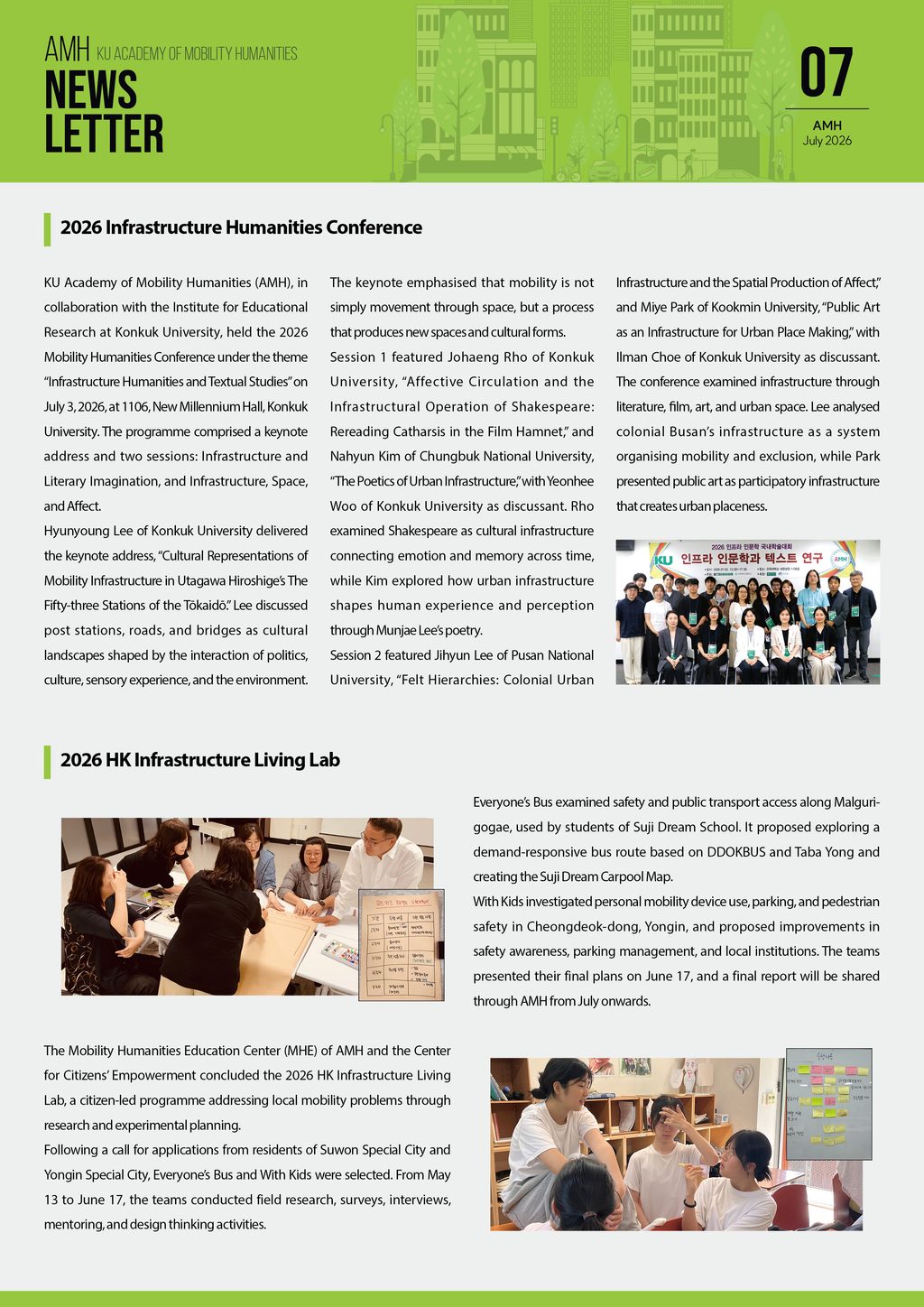
Two titles from the Mobility Humanities Series published by KU Academy of Mobility Humanities (AMH) have been selected for the 2026 Sejong Books (Academic Category), organized by the Ministry of Culture, Sports and Tourism and the Publication Industry Promotion Agency of Korea.
The Sejong Books selects outstanding academic and general interest publications for distribution to public libraries and other institutions, with the aim of promoting knowledge dissemination and reading culture. This year, a total of 345 titles were selected in the academic category across ten disciplines, including the humanities, social sciences, and natural sciences.
The selected titles from AMH are as follows:
■ Mobility Humanities Series: Assemblage
Infrastructures of the Anthropocene (2025)
This volume examines the crisis of the Anthropocene from the perspective of infrastructure and explores the possibility of a shift from anthropocentric to post-anthropocentric infrastructure. By extending the scope of infrastructure to the environment, the planet, and digital media, the book moves beyond the binaries of nature/culture and human/nonhuman to consider new forms of relations and responsibility through which humans and nonhumans coexist.
■ Mobility Humanities Series: Interconnect
Imperial Infrastructure and Spatial Resistance in Colonial Literature, 1880–1930 (2025)
This volume analyzes the relationship between imperial infrastructure and spatial resistance through colonial literature written between 1880 and 1930. Using “infrastructural reading” to examine representations of infrastructure such as roads and railways in literary texts, the book traces the material and spatial power of empire and the diverse forms of resistance to it. It also considers how the global expansion of infrastructure was connected to the growing instability and eventual disintegration of the British Empire.
The selection reflects the research achievements of AMH in the field of Infrastructure Humanities. AMH will continue to examine a wide range of issues surrounding mobility and infrastructure from humanities perspectives and to promote the wider dissemination and sharing of its research.
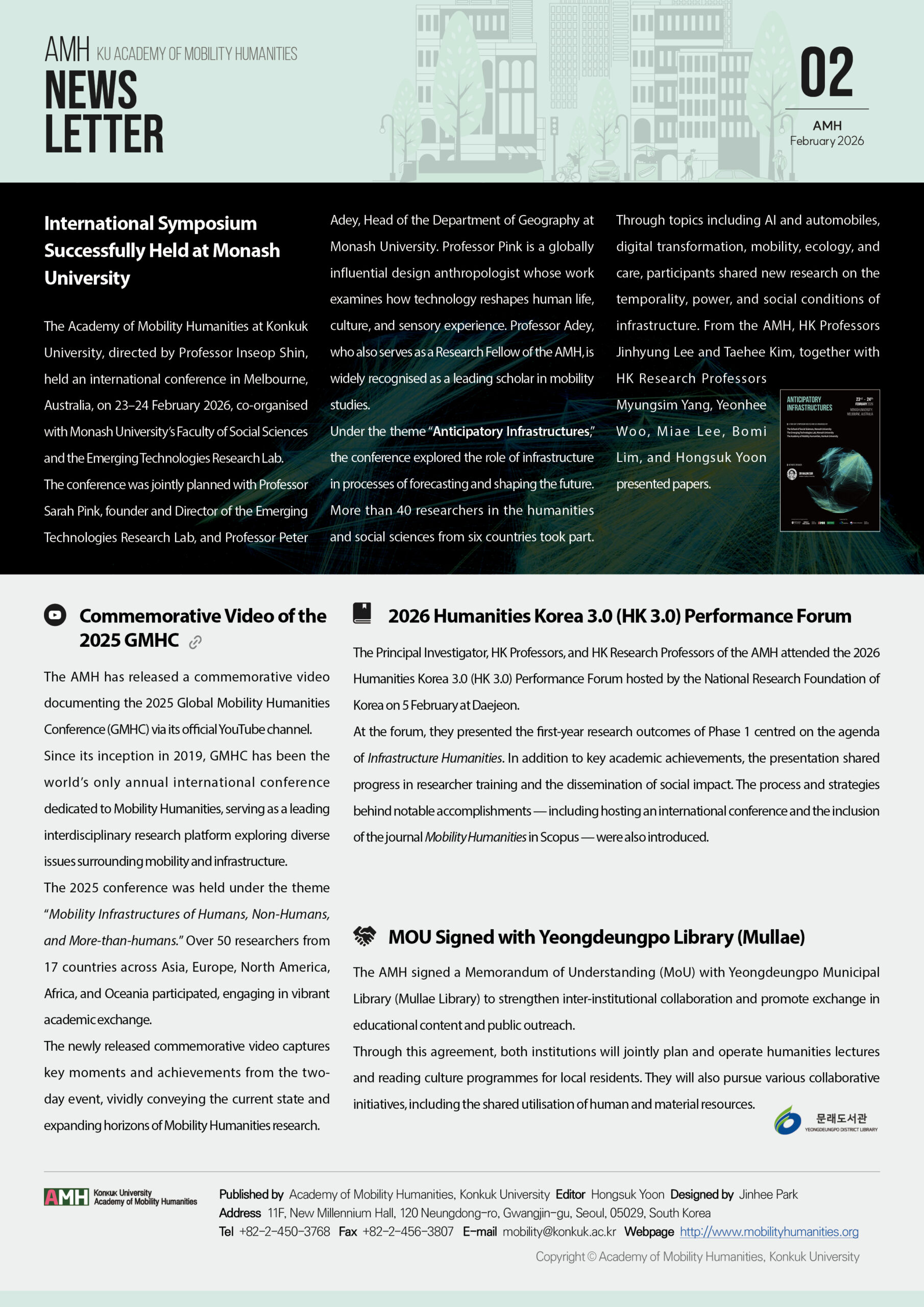
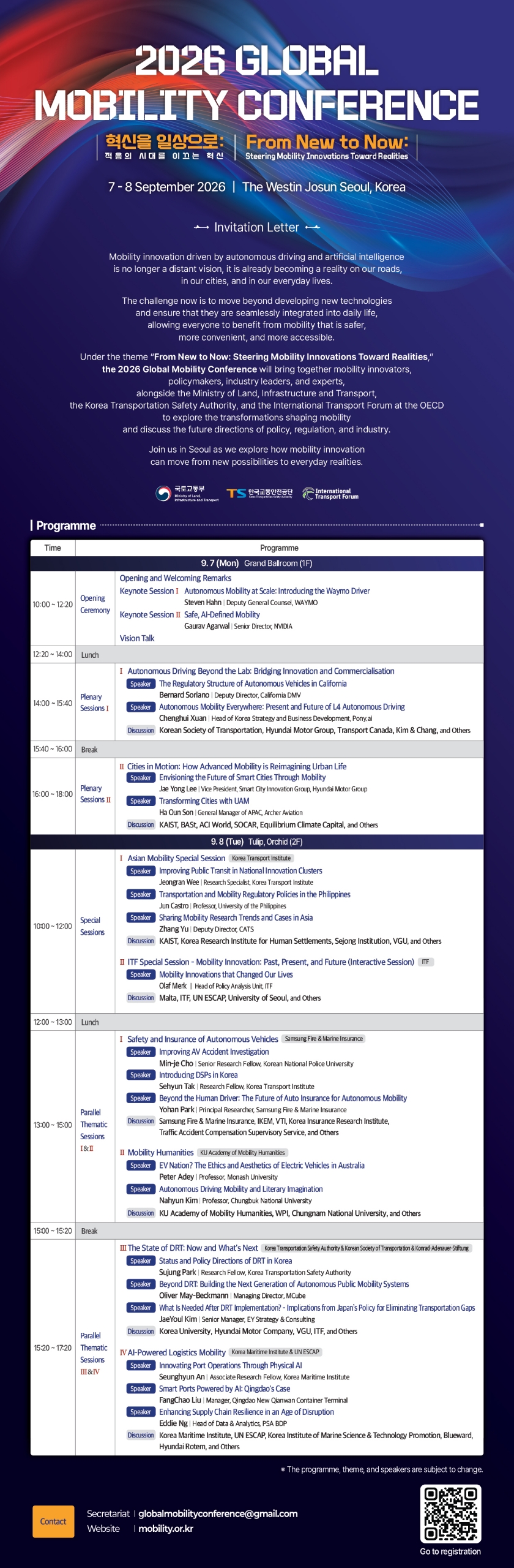
The KU Academy of Mobility Humanities (AMH) will once again participate as a co-organizer of the 2026 Global Mobility Conference, following its participation last year. The conference is hosted by the Ministry of Land, Infrastructure and Transport, the Korea Transportation Safety Authority, and the International Transport Forum at the OECD. It will take place from 7 to 8 September at The Westin Josun Seoul Hotel. These names and venue follow the official conference website.
The Global Mobility Conference introduces Korea’s innovations and vision in advanced mobility to an international audience and provides a forum for discussing the present and future of mobility since 2023. Under this year’s theme, “From New to Now: Steering Mobility Innovations Toward Realities,” government representatives and experts from industry and academia will come together to discuss the changes and challenges arising from rapidly evolving mobility environments and technological innovation.
On 8 September, researchers affiliated with the AMH in Korea and abroad will participate in Parallel Thematic Session II: Mobility Humanities. Peter Adey of Monash University, an AMH Researcher, will give a presentation, with Jinhyoung Lee, HK Professor at the AMH, serving as chair. Mimi Sheller of Worcester Polytechnic Institute, an AMH Distinguished Advisor, and Johaeng Rho, HK Research Professor at the AMH, will participate as panellists.
The session will extend discussions of future mobility beyond technology, industry, and policy to questions of human experience and values, culture, and ethics. It is expected to provide an opportunity to consider rapidly changing mobility environments together from a humanities perspective.
The 2026 Global Mobility Conference is open to participants through advance registration. Further information on the programme and registration is available on the conference website.
・Conference website: https://mobility.or.kr/
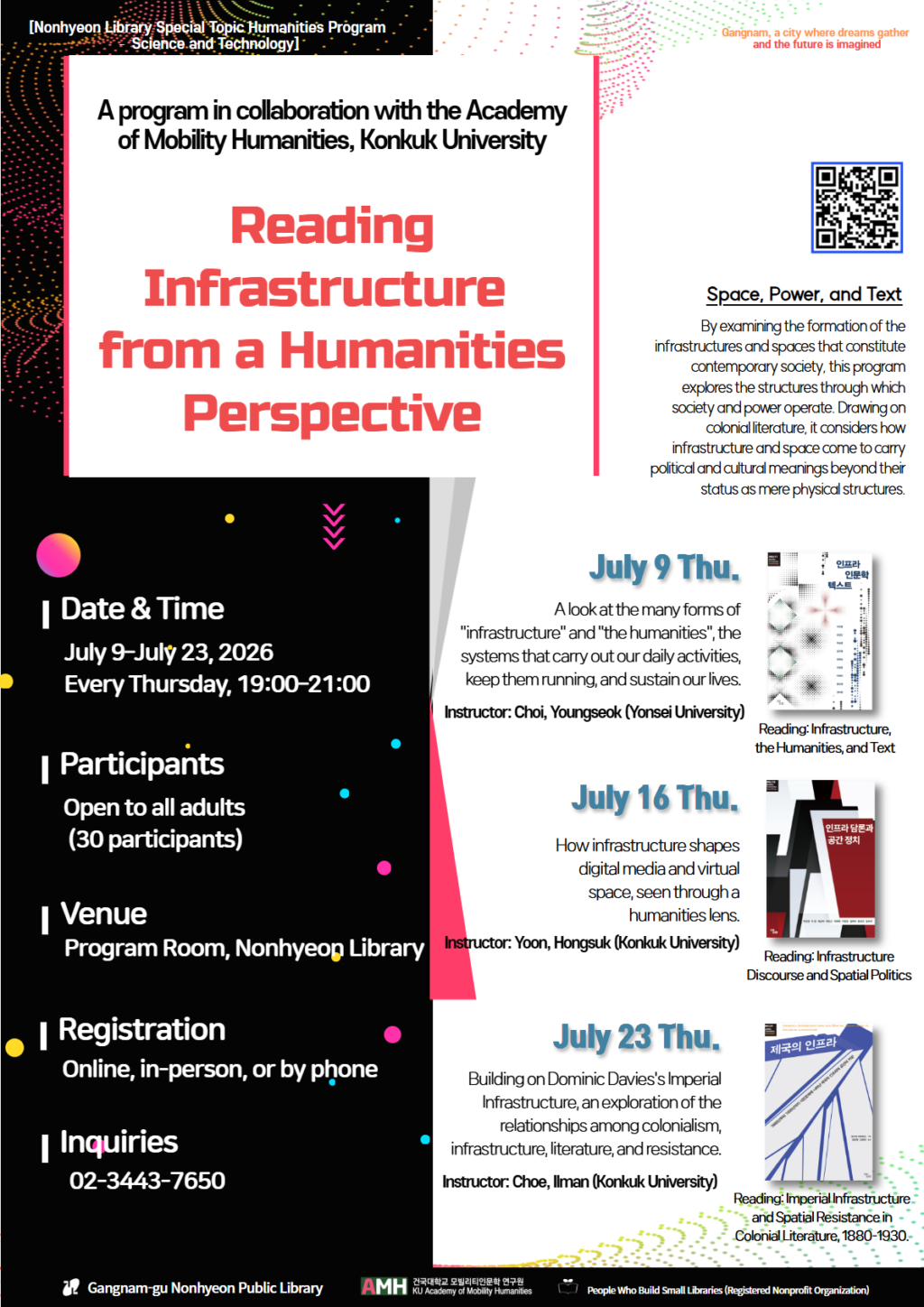
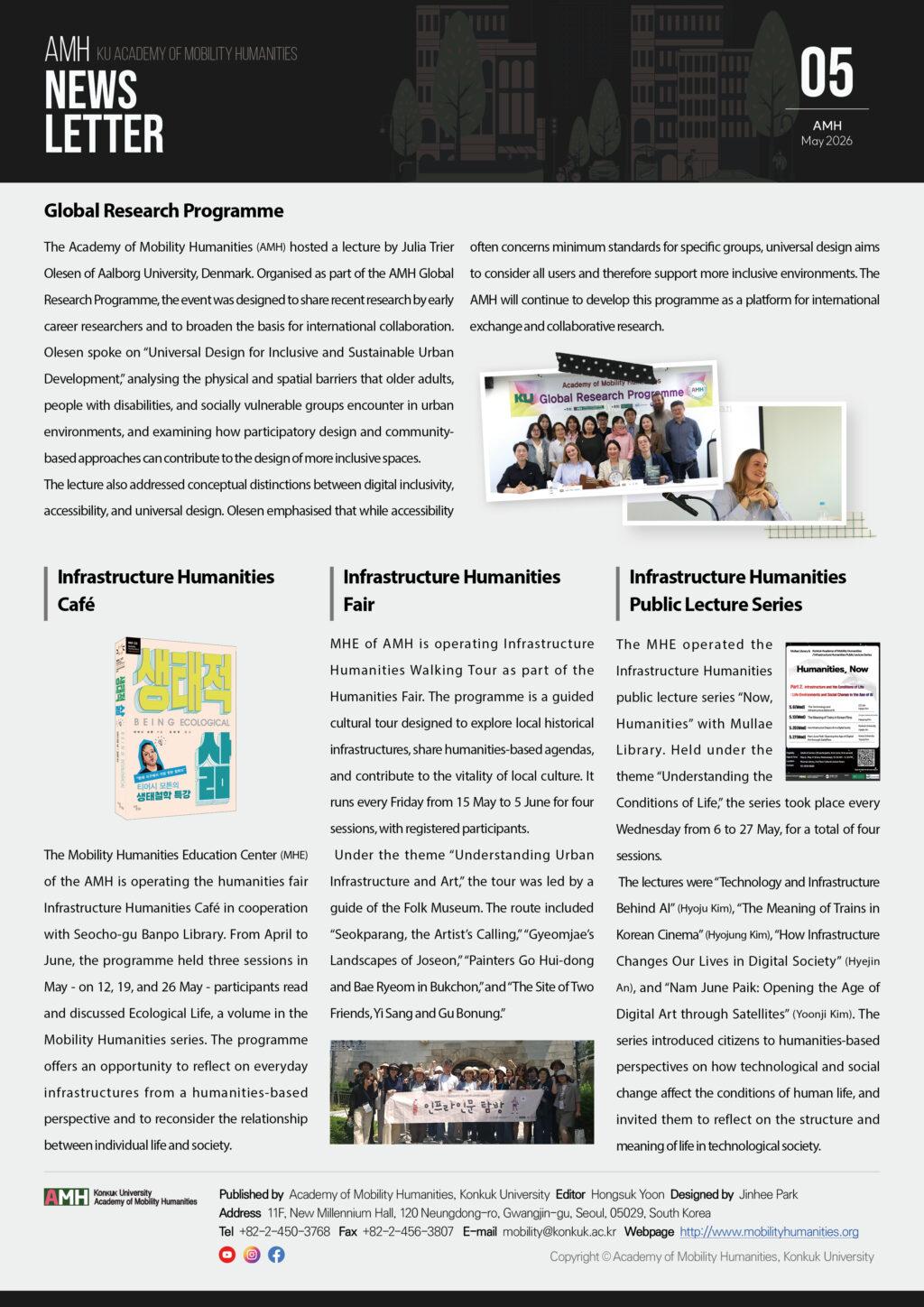
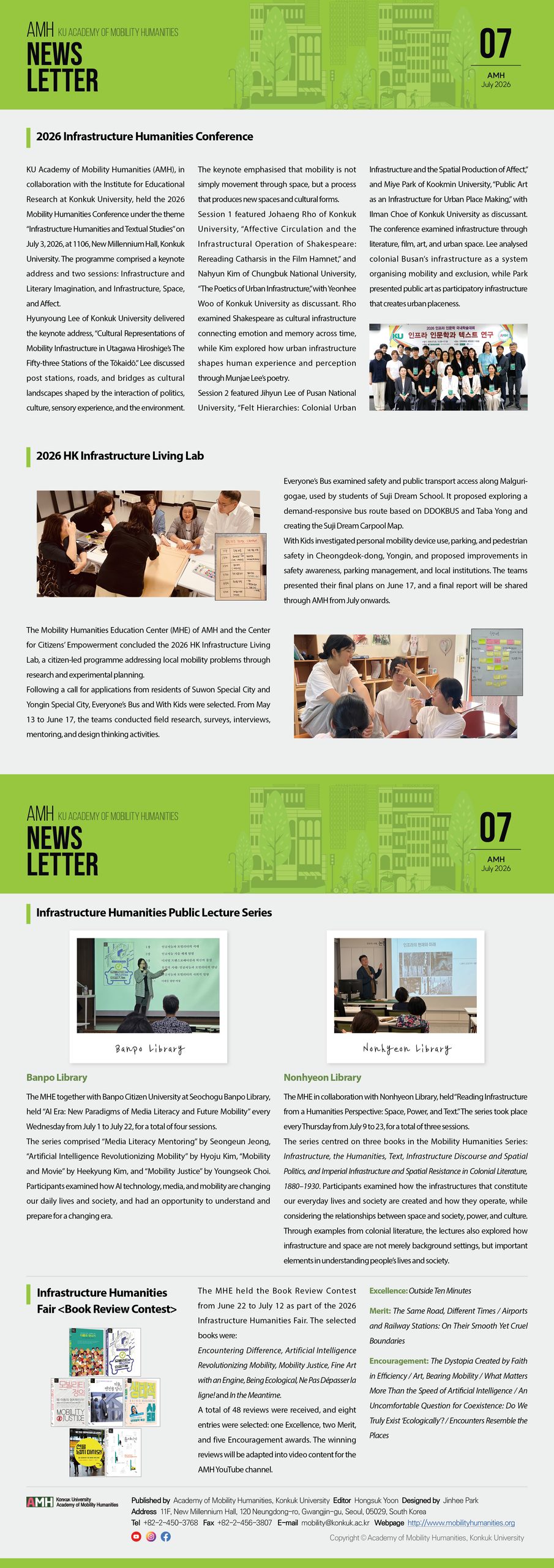
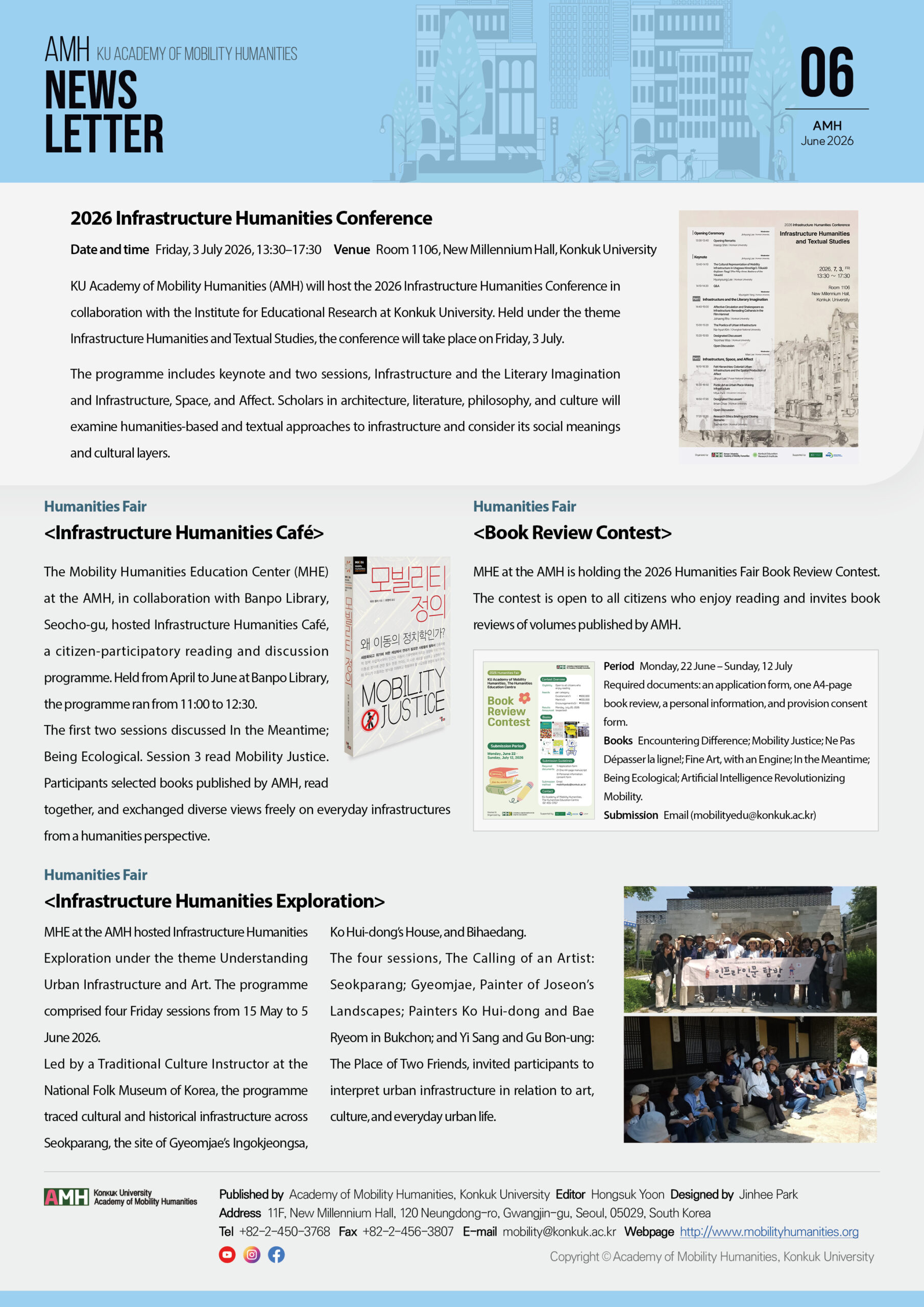
The Humanities Education Center (MHE) of KU Academy of Mobility Humanities (AMH), in collaboration with Nonhyeon Library, will hold an Infrastructure Humanities public lecture series.
By examining the formation of the infrastructures and spaces that constitute contemporary society, this program explores the structures through which society and power operate. Drawing on colonial literature, it considers how infrastructure and space come to carry political and cultural meanings beyond their status as mere physical structures.
✔️ Program Period: Thursday, July 9 – Thursday, July 23, 2026, 19:00–21:00
Every Thursday, three sessions
✔️ Format: In person / Program Room, Nonhyeon Library
✔️ Participants: Open to all adults (30 participants)
✔️ Fee: All lectures are free of charge
July 9 Thu.: Infrastructure, the Humanities, and Text
Instructor: Choi, Youngseok (Yonsei University)
July 16 Thu.: Infrastructure Discourse and Spatial Politics
Instructor: Yoon, Hongsuk (Konkuk University)
July 23 Thu.: Imperial Infrastructure and Spatial Resistance in Colonial Literature, 1880-1930
Instructor: Choe, Ilman (Konkuk University)
📌 Registration Period: Wednesday, June 17, 2026, 09:00 – Thursday, July 9, 2026, 18:00
📌 Applications are available via the QR code at the top of the poster. For inquiries, please call 02-3443-7650.
📌 Gangnam-gu Nonhyeon Public Library website:
https://library.gangnam.go.kr/nhlib/menu/10213/program/30013/lectureList.do

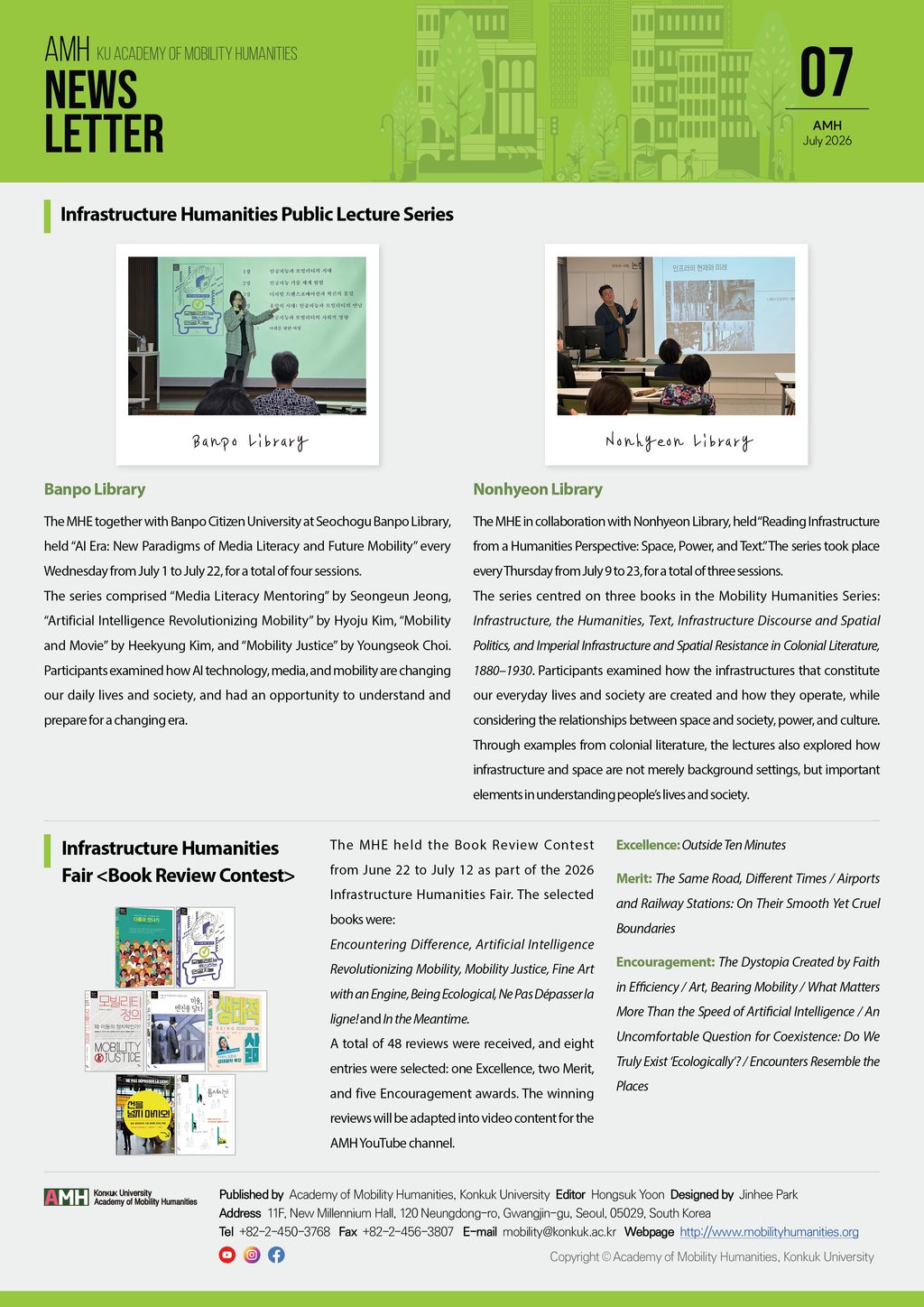
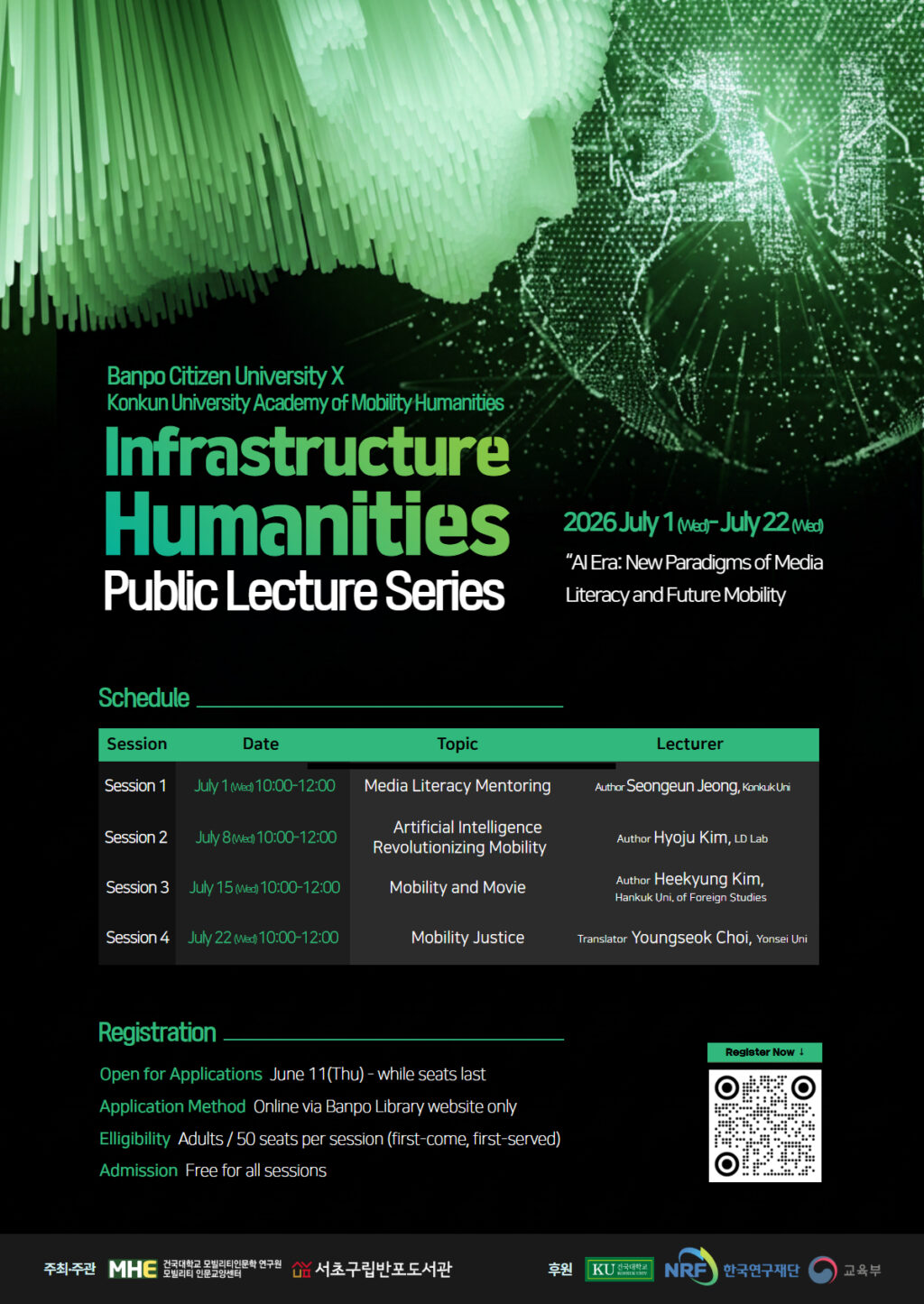
The Humanities Education Center (MHE) of the KU Academy of Mobility Humanities (AMH), in cooperation with Banpo Citizen University at Seochogu Banpo Library, is holding an Infrastructure Humanities public lecture series.
“AI Era: New Paradigms of Media Literacy and Future Mobility”
✔️ Period: Wednesday 1 July – Wednesday 22 July 2026, 10:00–12:00 (Every Wednesday, four sessions in total)
✔️ Format: In person / Seochogu Banpo Library
✔️ Participants: Adults / 50 participants per lecture, on a first-come, first-served basis
✔️ Fee: Free for all sessions
📌 Registration period: Thursday 11 June 2026 – while seats last
📌 Applications are available online via the Banpo Library website only (Applications by phone or in person are not available).
📌 Seochogu Banpo Library website
https://www.seocholib.or.kr/

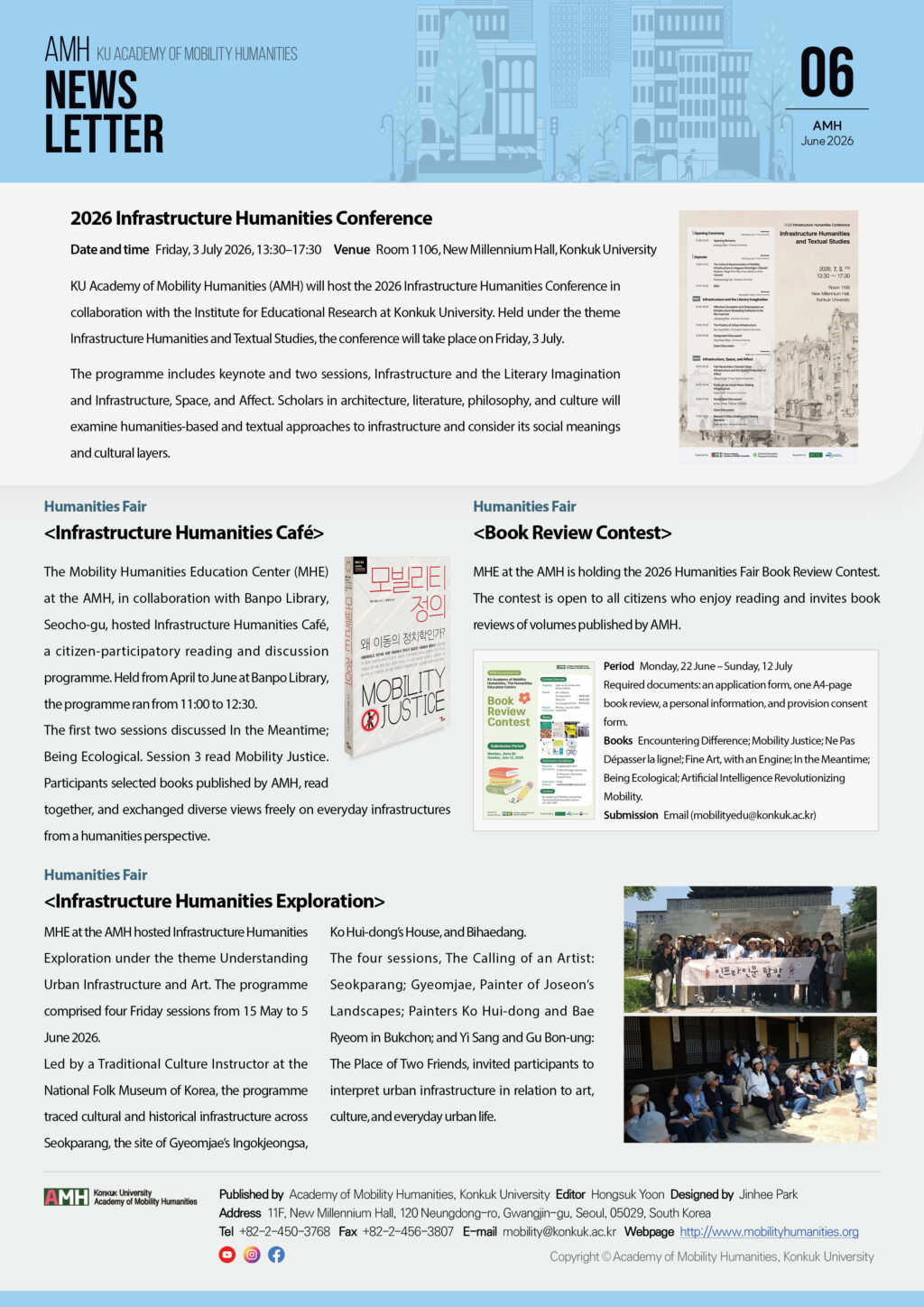
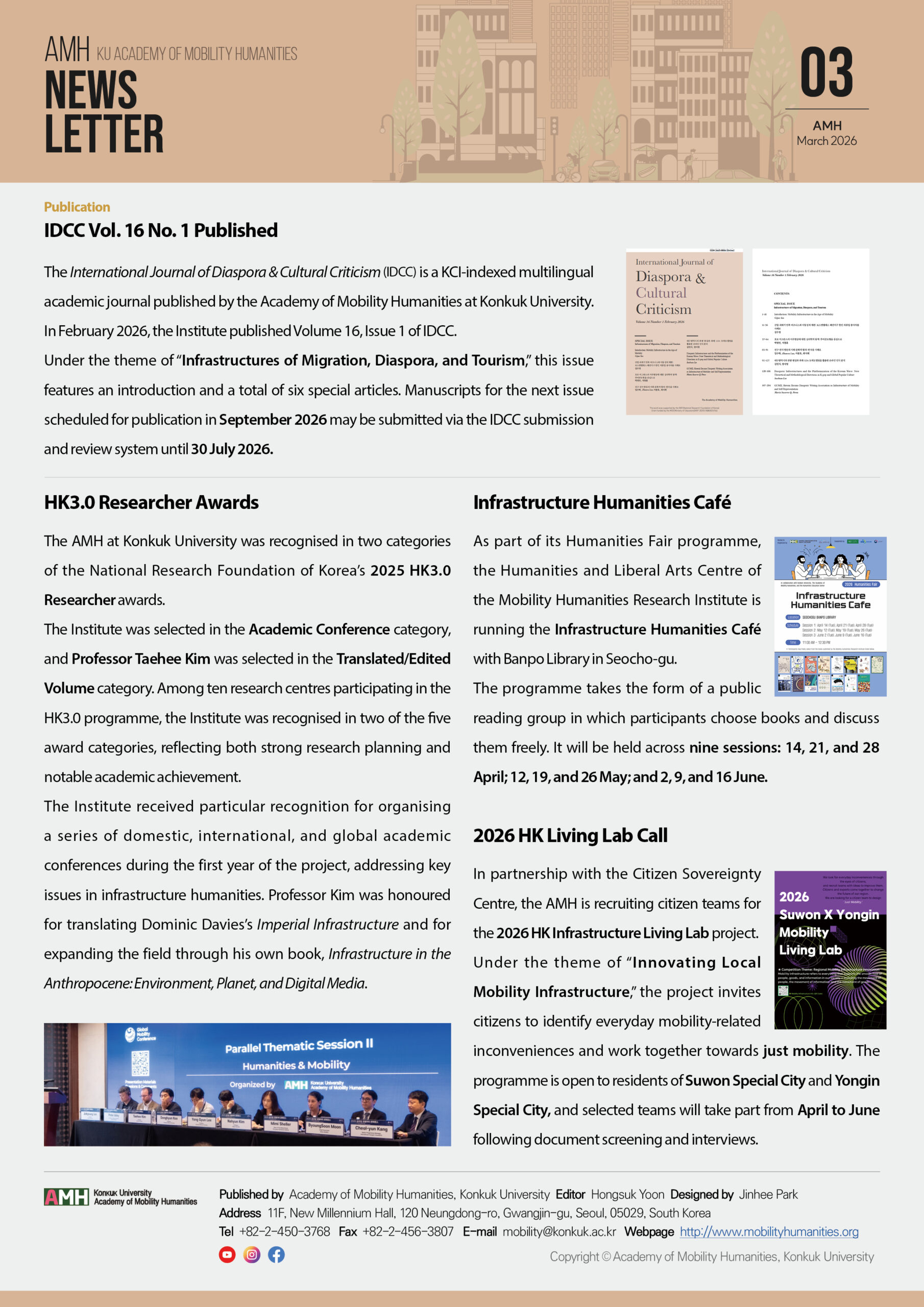
The Academy of Mobility Humanities at Konkuk University, directed by Professor Inseop Shin, has once again demonstrated its exceptional research competitiveness by being selected in two categories of the ‘2025 HK3.0 Researcher’ awards organised under the National Research Foundation of Korea’s Humanities Korea 3.0 (HK3.0) support programme.
In this year’s awards, ten research centres from across the country participated, and the Academy and its affiliated researcher achieved the remarkable distinction of winning two out of the five categories.
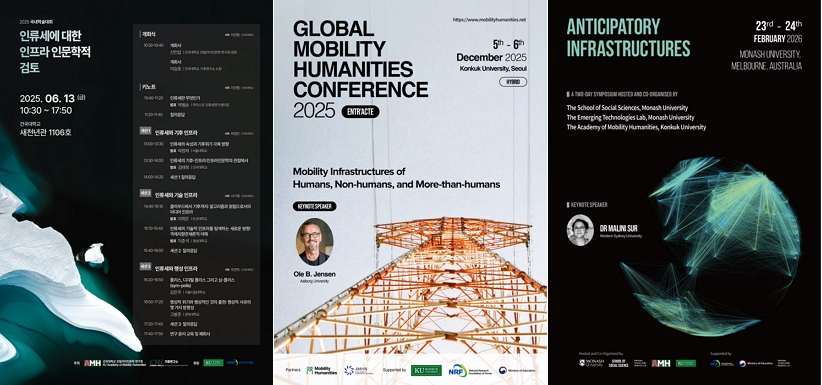
During the first year of the project, the Academy established Infrastructure Humanities as its core agenda and has continuously organised academic conferences both in Korea and abroad. In particular, it received high praise for its strong planning and execution in addressing the major issues of infrastructure humanities in depth, while internationally sharing research outcomes and broadening academic discussion.

(HK Professor Taehee Kim)
Professor Taehee Kim has contributed to the expansion of infrastructure studies by introducing major global research trends to Korean audiences through the translation of Dominic Davies’s Imperial Infrastructure, and by publishing Infrastructure in the Anthropocene: Environment, Planet, and Digital Media. Through these works, Professor Kim has added significant academic value by examining infrastructure from multiple perspectives, including environment, planetarity, and digital media.

Now in the second year of its HK3.0 project, the Academy of Mobility Humanities will continue to expand the academic and social impact of its research through the following activities:
The Academy will continue striving to establish itself as a world-class research institute leading the field of Infrastructure Humanities. We extend our sincere thanks to all members of the Academy and to everyone who has shown us their support and interest.