2026 HK Infrastructure Living Lab
Wednesday 13 May 2026 / Academy of Mobility Humanities ・ Citizens’ Empowerment Centre
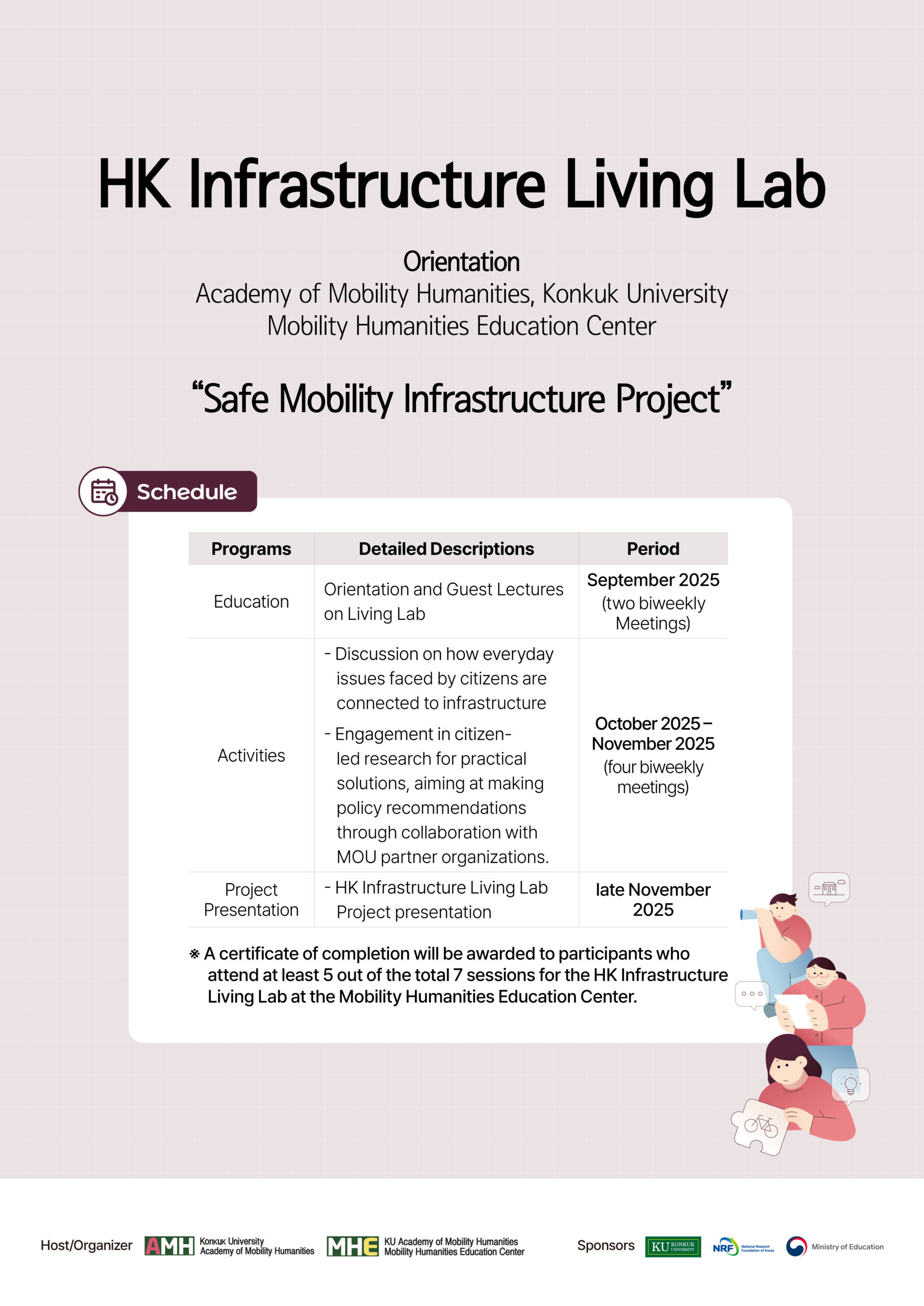
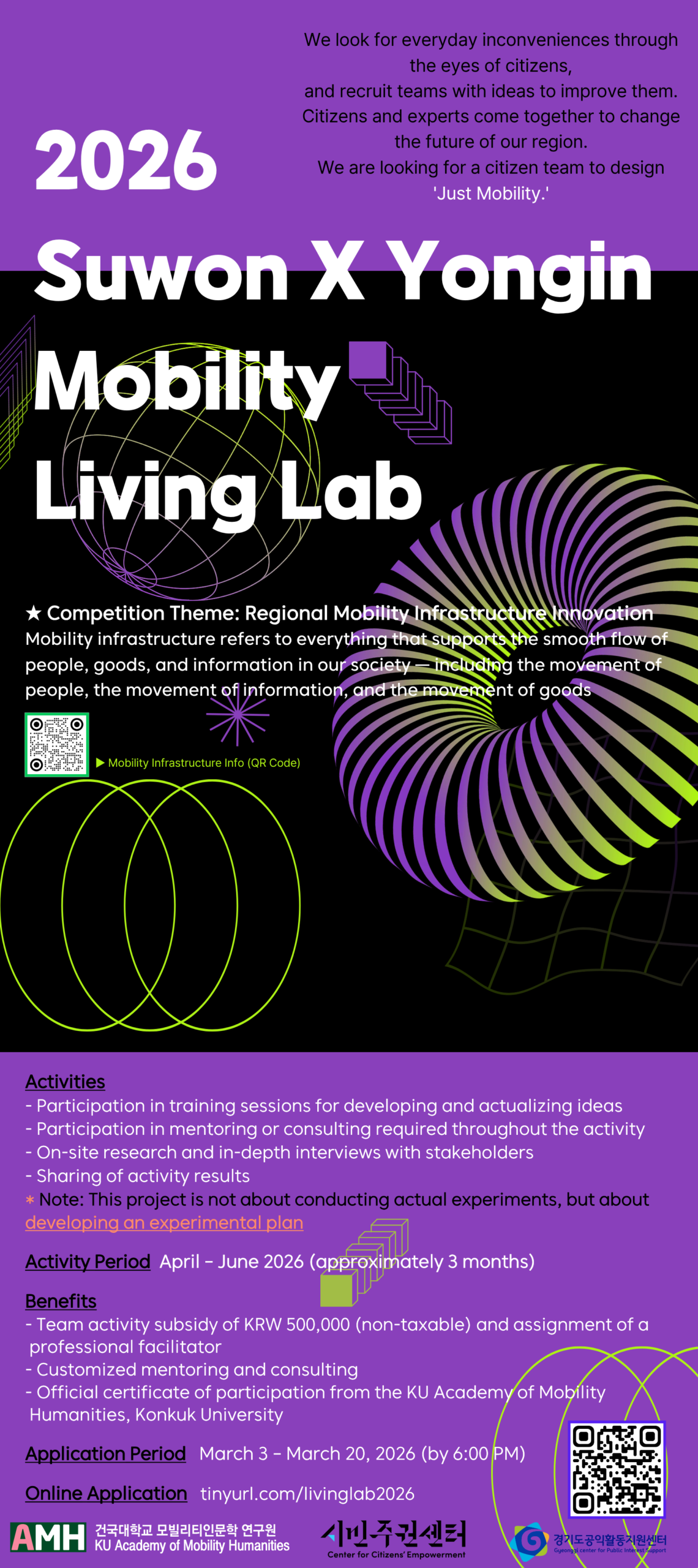
The Academy of Mobility Humanities’ 2026 HK Infrastructure Living Lab seeks to establish a collaborative problem-solving model in which citizens, the public sector, and experts work together to address the various challenges facing local communities, and to foster a sustainable ecosystem of regional innovation through field-centred idea generation and experimentation. To this end, it supports the process of developing and realising ideas, so that anyone can readily take on the challenge of solving local problems.
◎ Call for proposals: Innovation in local mobility infrastructure
◎ Theme: Exploring processes for solving local problems identified in everyday life — Mobility infrastructure innovation in Suwon Special City and Yongin Special City
◎ Application period: Tuesday 3 March – Friday 20 March 2026, 18:00
◎ Eligibility: Residents of Suwon Special City and Yongin Special City; groups of five or more
◎ Activity period: April – June 2026 (approximately three months)
◎ Activities:
- Participation in training to refine ideas and draw up plans for putting them into practice
- Participation in mentoring or consulting as required during the process
- Field research and in-depth interviews with stakeholders
- Sharing of activity outcomes
※ This project does not involve carrying out actual experiments; rather, it is a process of drawing up experimental plans.
kfclub@hanmail.net | +82-10-8761-1504
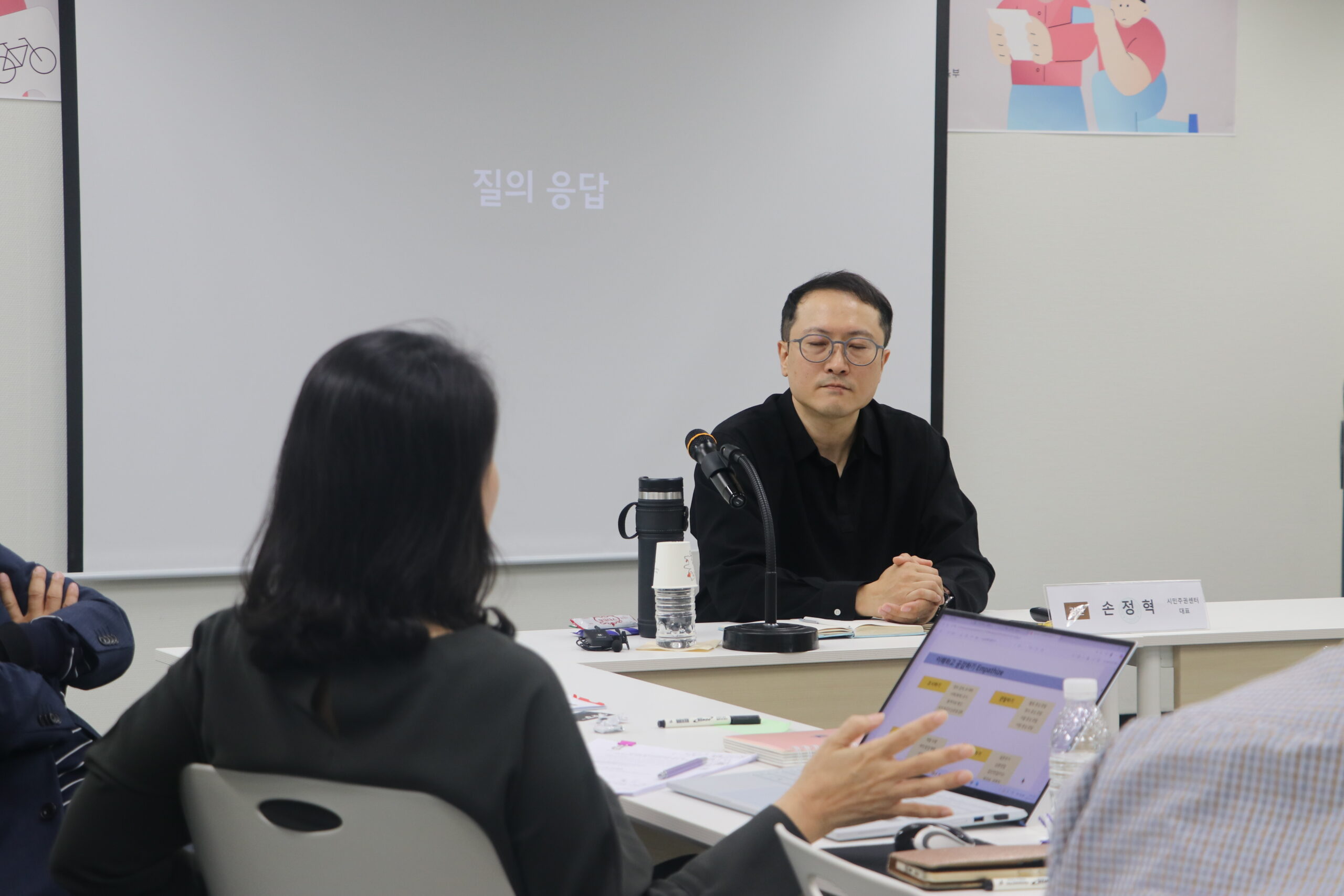
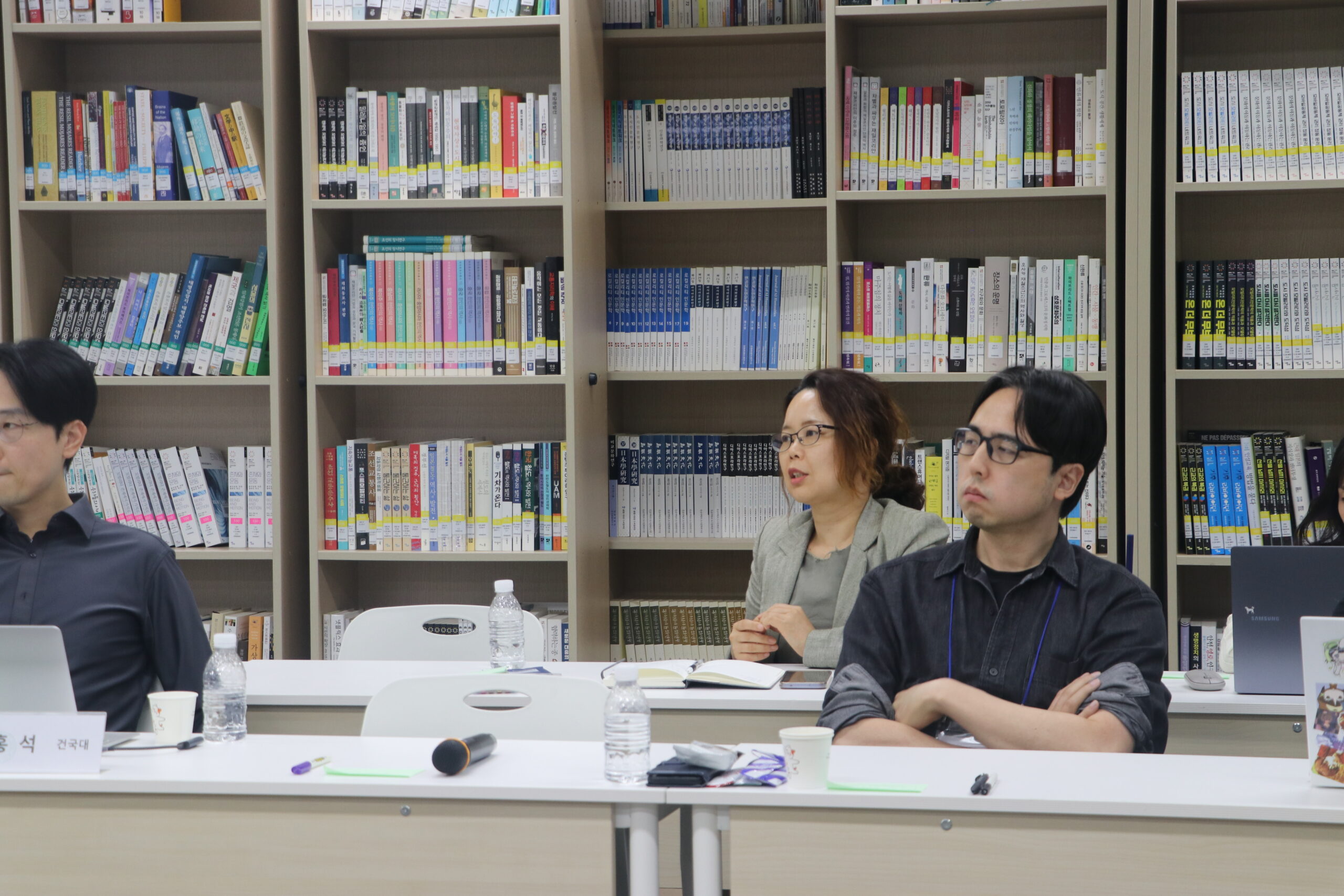
2026 HK Infrastructure Living Lab Orientation
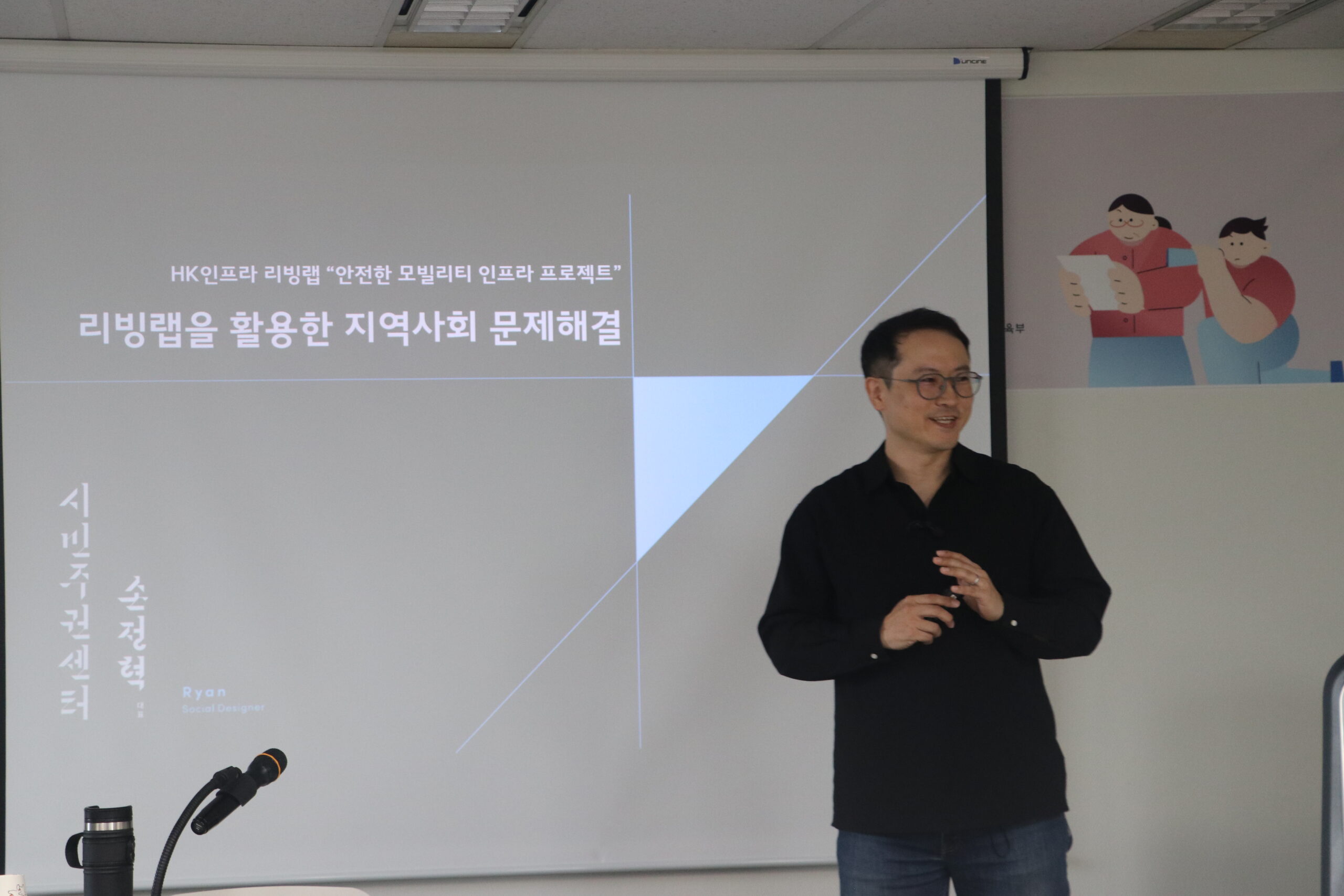
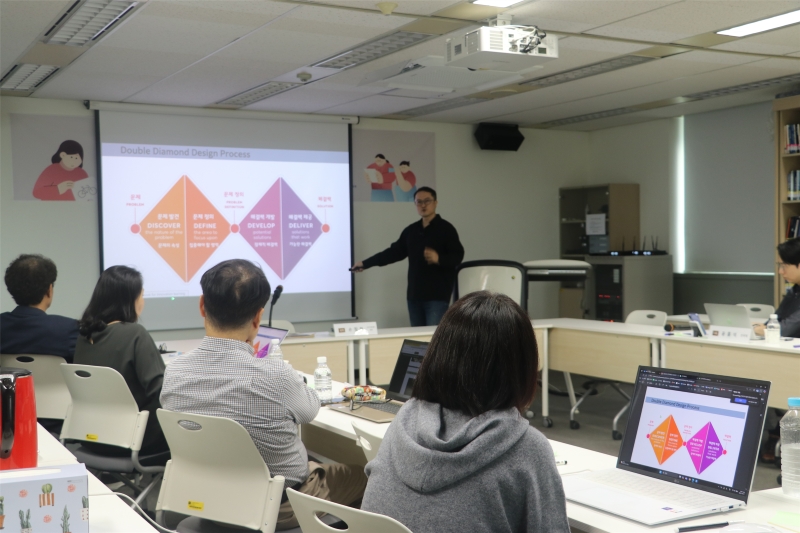
The HK Infrastructure Living Lab, together with the Citizens’ Empowerment Centre, successfully held an orientation and introductory training session to help participants understand the aims and operating methods of the 2026 Suwon–Yongin Mobility Living Lab project and to prepare for the team projects to follow.
◎ Date: Wednesday 13 May 2026
◎ Content: Project briefing, team introductions, introductory training in social living labs and design thinking, and the drawing up of project plans for each team
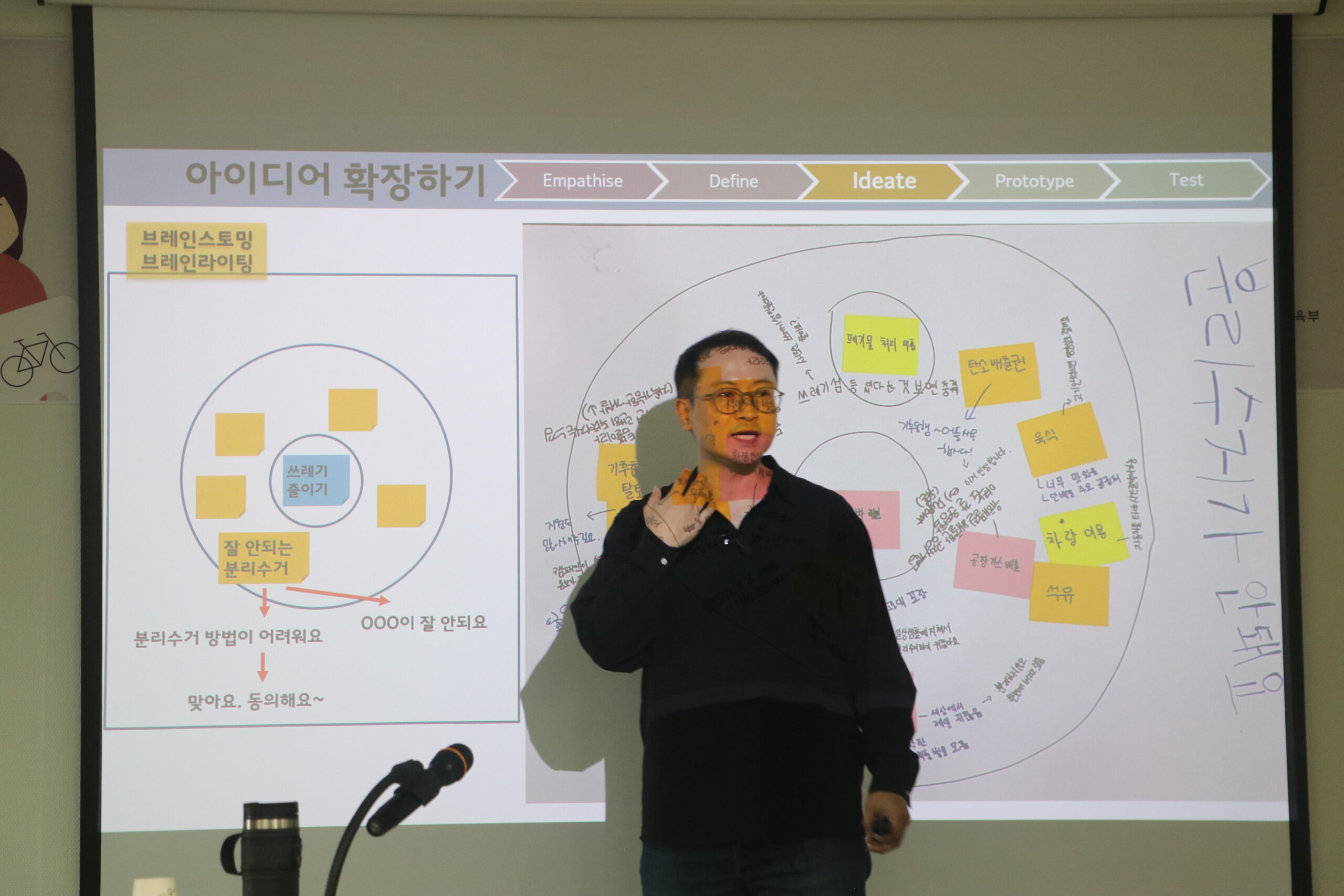
◎ Training: Sharing of the concept of the living lab and methods of co-production, the design thinking process, local case studies, and methods for defining problems, and developing solutions
◎ Activity plan: The participating teams will carry out their respective projects over a period of about five weeks, from 13 May to 17 June, and will share weekly activity records along with outputs.
The HK Infrastructure Living Lab and the Citizens’ Empowerment Centre will provide mentoring and training based on each team’s plans. They will also operate an ongoing channel of communication throughout the entire process — from identifying and defining problems to developing solutions — and will provide continuous support. In addition, on 17 June an outcome-sharing and evaluation workshop will be held to compile the results and to review the project process.


Problem-Definition Activities with Citizens
Following the orientation held on 13 May, the participating teams began the second stage of the HK Infrastructure Living Lab: problem-definition activities. Using the 5 Whys method introduced by the Citizens’ Empowerment Centre, the teams examined the underlying causes of local issues and redefined them on an evidence-based foundation.
◎ Everyone’s Bus: From 19 to 22 May, the Everyone’s Bus team addressed safety issues on Malguri-gogae, a school route used by students of Suji Dream School. The team examined the risks faced by pedestrian students on a narrow, steep road frequently used by dump trucks, as well as the lack of realistic transport options other than private cars. Through the 5 Whys method, the team identified the need for further field research and developed a step-by-step plan centred on surveys, site visits, and public outreach.
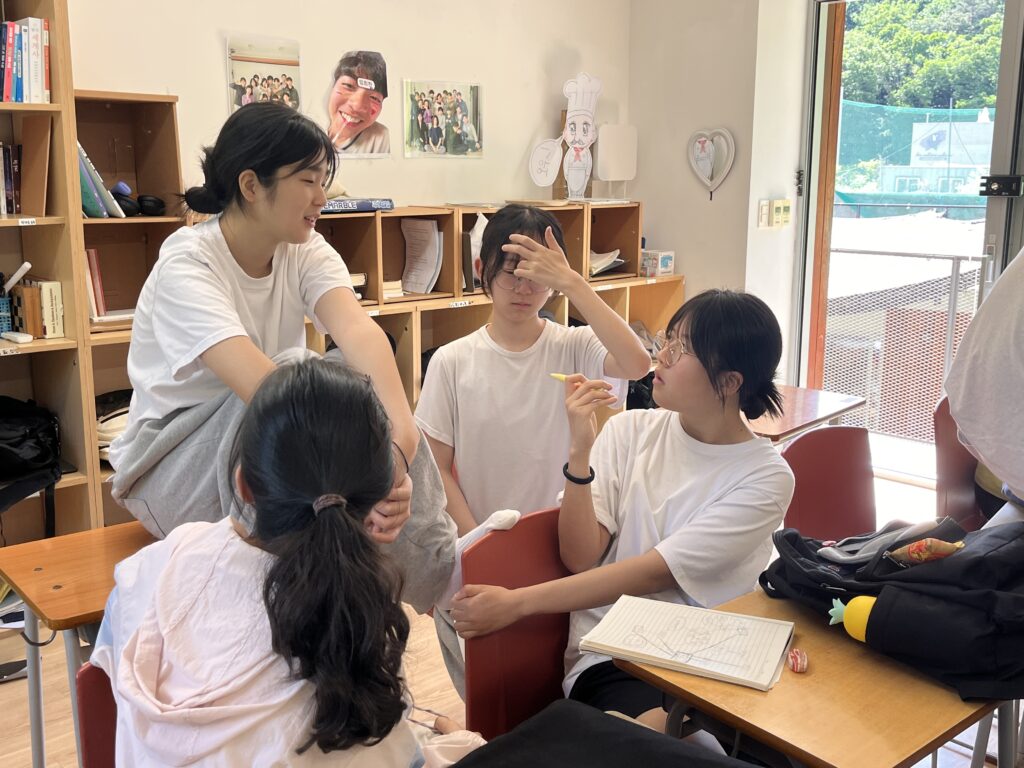
◎ With Kids: Under the theme of an urban mountain village, the With Kids team explored school-route and commuting issues in Cheongdeok-dong, Yongin. Focusing on children’s lower eye level, the team investigated slopes, scooter parking, and pedestrian conditions, then redefined the issue based on field feedback. They proposed future activities including an action-camera walking experience group and a nudge design experiment involving residents and students.
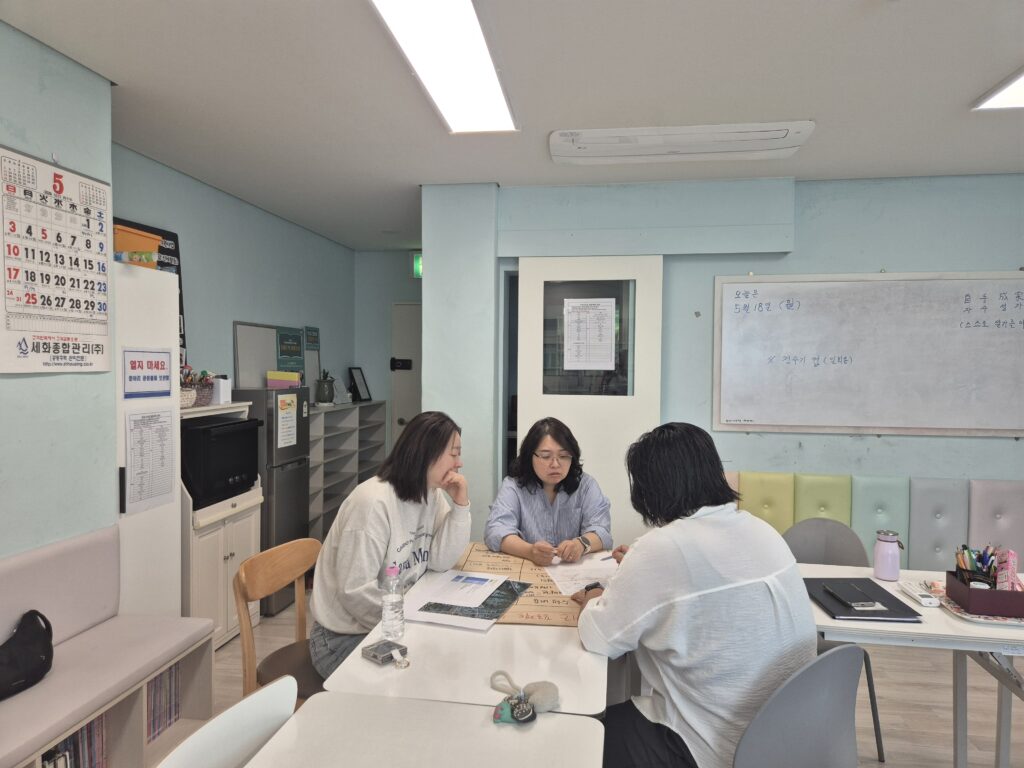
The HK Infrastructure Living Lab and the Citizens’ Empowerment Centre will continue to provide personalised mentoring and consulting based on each team’s plan and activity records.
Activities to Plan Experiment
After completing the problem-definition stage, the participating teams spent June refining solutions and developing experimental plans through fieldwork, stakeholder engagement, surveys, and consultation.
◎ Everyone’s Bus: The team refined a poster on Malguri-gogae and a survey for expanding DDOKBUS, a demand-responsive transit service, and prepared an enquiry to Yongin City’s Transportation Division. It also outlined the “Suji Dream Carpool Map,” gathering initial data through analogue mapping before expanding it into an AI-enabled application, with reference to Taba Yong, Yongin’s demand-responsive transit service.
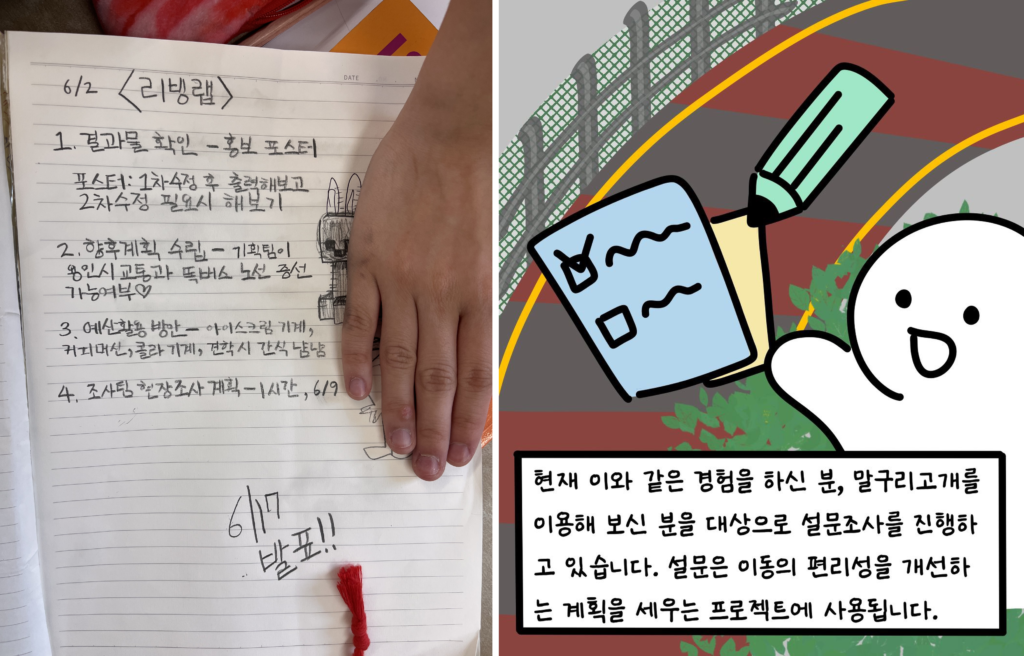
◎ With Kids: The team tested personal mobility devices (PMs) to identify risks, reviewed laws, local ordinances, and previous studies, and designed a parent survey. It drew on the Citizen Communication Division’s “Village Experiment Lab” case at Yongin City Hall, attended a parent education workshop at Chodang Middle School, observed a “Village Living Lab” interim presentation, and conducted an FGI with the Jungil Elementary School parents’ association. These activities informed requests for amendments to local ordinances.
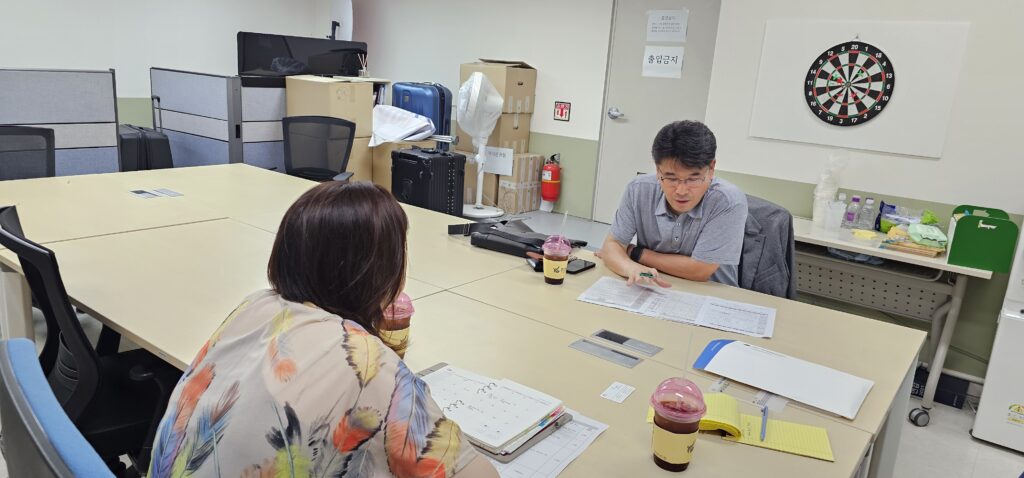
The teams presented their final experimental plans at the outcome-sharing and evaluation workshop on 17 June.
Outcome Sharing and Completion
The 2026 Suwon x Yongin Mobility Living Lab concluded with the outcome-sharing and evaluation workshop on 17 June. Over five weeks, participants conducted field research, gathered opinions, reviewed cases, and developed experimental plans. Presentations, mutual feedback, and a question-and-answer session were followed by certificates of completion and commemorative photographs.
◎ Everyone’s Bus: Through site visits and surveys, the team examined pedestrian safety and public-transport access along the Malguri-gogae school route. It developed an experimental plan to review a demand-responsive bus route and establish the “Suji Dream Carpool Map” based on school commuting routes.
◎ With Kids: Through observation, direct experience, parent feedback, and FGIs, the team examined PM use and parking, as well as pedestrian safety. It developed practical directions for safety awareness, parking management, and local institutional improvement.
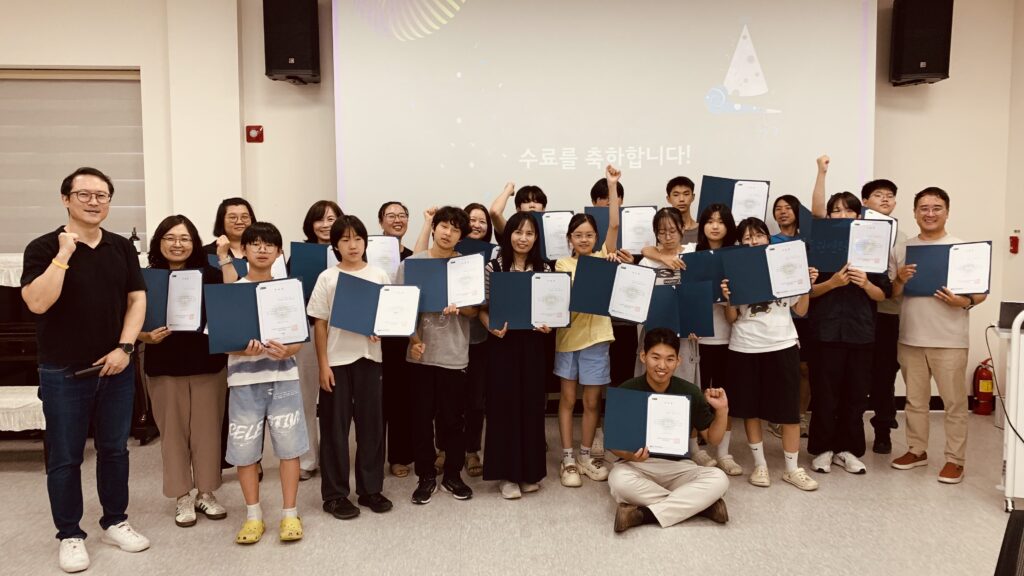
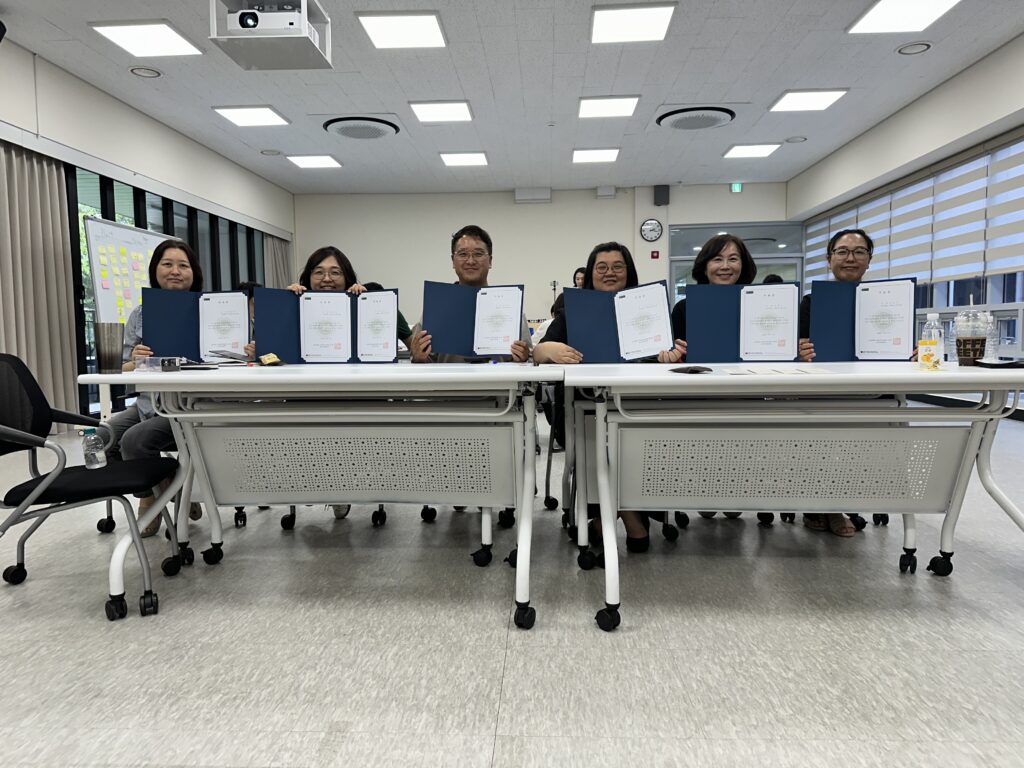
Together, the teams demonstrated how citizens can turn everyday mobility issues into experimental plans through investigation, consultation, and collaboration. A final report integrating their records, outcomes, and support from the Citizens’ Empowerment Centre will be shared through the Academy of Mobility Humanities from July onwards.