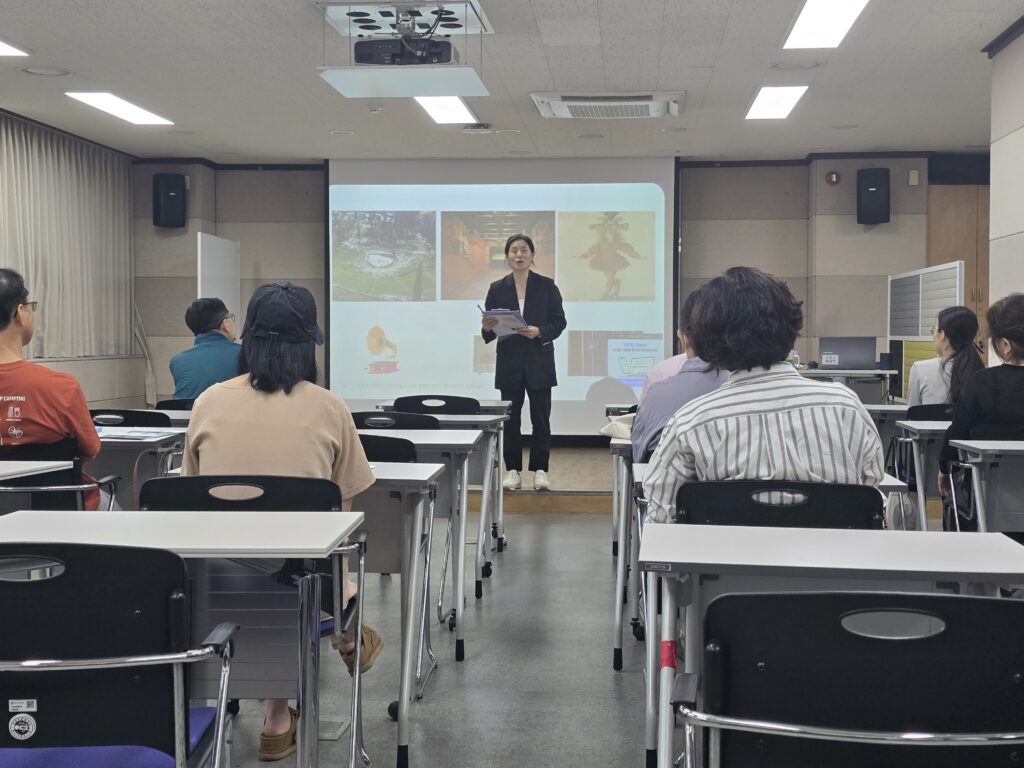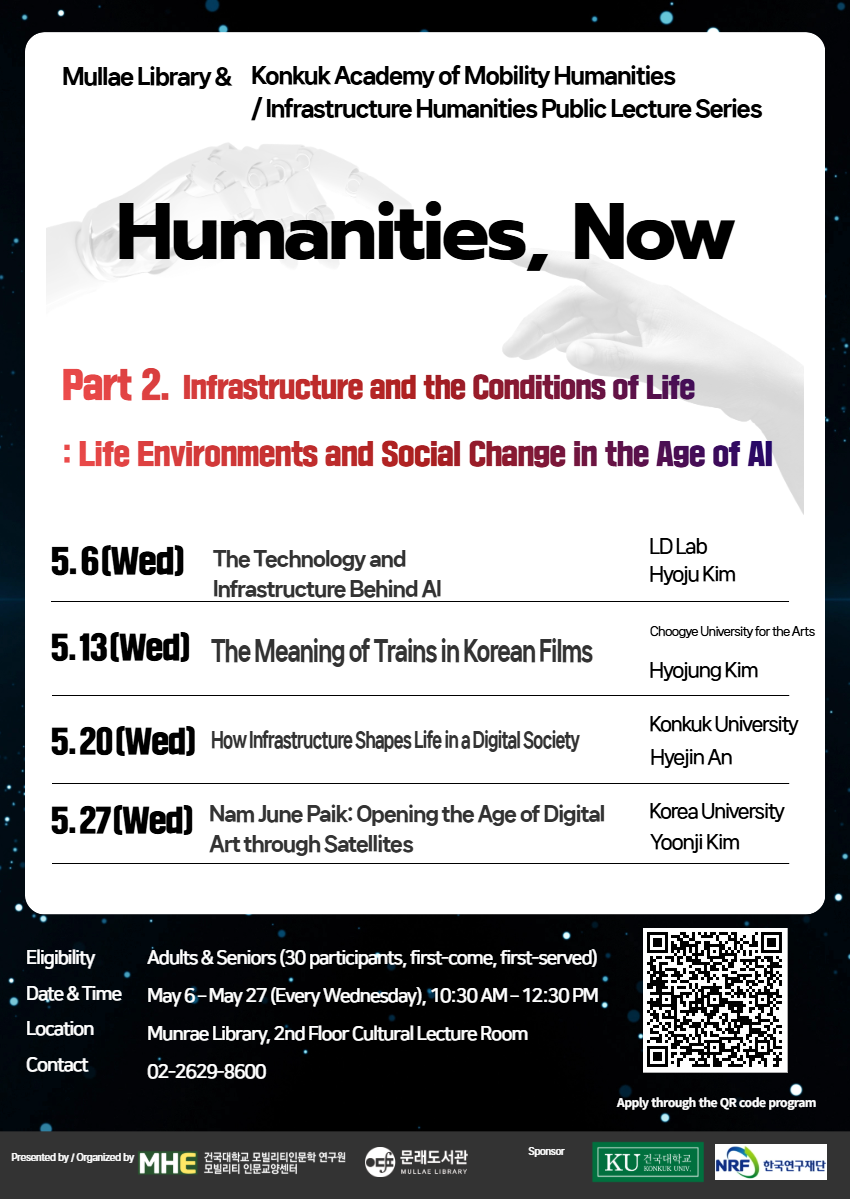
1. Art, Who Are You?
Upside down, in reverse, and toward an open world: Nam June Paik as a leading figure
2. Discussing the Life and Works of Nam June Paik
Nam June Paik was born in Seorin-dong, Jongno-gu, Seoul, in 1932, then Seorin-jeong, Gyeongseong-bu, Gyeonggi-do during the Japanese colonial period. He was the youngest child of Paik Nak-seung and Cho Jong-hee, among three sons and two daughters. He attended Susong Elementary School and Gyeonggi First Higher Common School.
1949: Transferred to the Royden School in Hong Kong.
1952: Entered the College of Liberal Arts at the University of Tokyo, where he majored in art history and aesthetics, while beginning to study electronic engineering and cybernetics.
1956: Studied Western architecture, music history, and philosophy at the University of Munich and the University of Cologne.
1959: Presented the performance Hommage John Cage.
1963: Held his first exhibition, Exposition of Music – Electronic Television, at Galerie Parnass in Wuppertal, Germany, presenting an early form of what would later be called video art.
1964: Travelled to Japan and created Robot K-456.
1965: Began working with Sony’s Portapak, an early portable video recording system, a moment often discussed as a key point in the emergence of video art.
1967: Presented Opera Sextronique.
1973: Presented writings on the hybridisation of art and technology.
1984: Broadcast Good Morning, Mr. Orwell live via satellite on 1 January. The work connected New York and Paris in real time and has been widely discussed as a major example of Paik’s satellite art.
1989: Received the Kurt Schwitters Prize.
1992: Presented Nam June Paik · Video Time · Video Space at the National Museum of Contemporary Art, Korea, now the National Museum of Modern and Contemporary Art, Korea. The exhibition was the first large-scale retrospective of Paik in South Korea and attracted a record audience.
1993: Received the Golden Lion in the national pavilion section of the Venice Biennale.
1995: Received the Fukuoka Asian Culture Prize.
1996: Received the 5th Ho-Am Prize in the Arts.
1997: Received the Goethe Medal from the Goethe-Institut in New York.
1998: Received the Kyoto Prize from the Inamori Foundation in Japan.
2000: Awarded the Geumgwan Order of Cultural Merit, the first class of the Order of Cultural Merit.
2001: Received the Lifetime Achievement in Contemporary Sculpture Award from the International Sculpture Center in Hamilton, New Jersey.
2002: Signed the agreement to establish the Nam June Paik Art Center. The centre opened in 2008.
2006: Passed away. He was later recognised by TIME as one of Asia’s heroes.
3. Opening the Age of Digital Art: The Story of Good Morning, Mr. Orwell
- By presenting works that departed radically from existing artistic conventions, Nam June Paik established a new artistic language of his own.
- He was a pioneer in the fullest sense, developing and repeatedly suggesting new engineering tools, methods, and artistic possibilities.
- Although his work often unfolded through resistance, destruction, and experiment, it never lost its subtle sense of balance and artistic coherence.
- Between lightness and seriousness, comedy and destruction, original form and transformation, Paik’s work opened a space for imagination and reflection.
“What we need in our lives today is the practical capacity to critically interpret infrastructural knowledge, phenomena, and experience with an open attitude, to select them with care, and to guide them toward better forms of life.”