


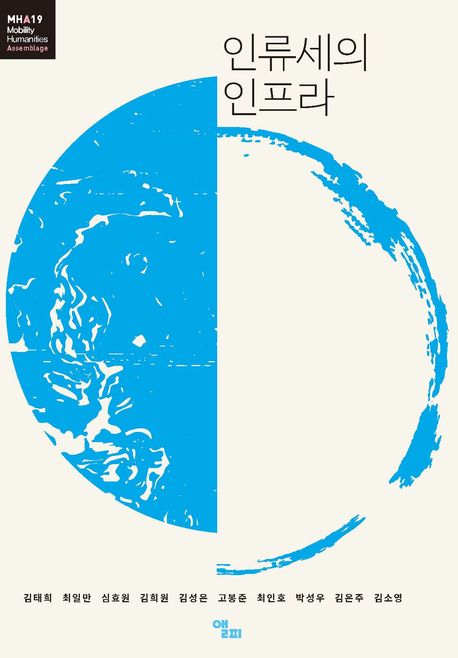
Beyond the Human/Non-Human:
Rethinking Infrastructure from a Planetary Perspective
From Anthropocentric Infrastructure to Post-Anthropocentric Infrastructure
This book examines the ways in which humans have appropriated the Earth itself, as environment, as infrastructure, focusing on discourses surrounding the Anthropocene. It also explores emerging theoretical perspectives that understand ecosystems as active agents. Infrastructure is among the most powerful material evidence of the advent of the Anthropocene, insofar as it constitutes one of its principal causes. The construction of infrastructure has consumed vast quantities of fossil fuels and depleted natural resources, thereby accelerating climate change and ecological destruction. While infrastructure enables human mobility and the circulation of materials, it also generates wide-ranging disturbances across the Earth system, including global warming, biodiversity loss, and various forms of pollution.
At the same time, infrastructure is also a crucial site for seeking responses to the crises of the Anthropocene. The “Anthropocene perspective”, which seeks “macro-level strategies for collective survival” through which we might escape the shared condition of extinction aboard a “burning Earth”, compels an “infrastructural turn” that directs critical attention towards infrastructure. Since the challenges posed by the Anthropocene urgently call for critical reflection on modern modes of thought grounded in binaries such as nature/culture and human/non-human, the infrastructural turn may also be understood as part of “a broader turn towards anti-anthropocentrism”.
Infrastructure in the Anthropocene:
Environment, Planet, and Digital Media
What infrastructural reflection ultimately foregrounds is human responsibility. To think of the environment, the planet, and hyperreality as infrastructure is both to dismantle the centrality of the human and to assign humans a renewed form of responsibility. This responsibility lies in reconstructing anthropocentric infrastructure as post-anthropocentric infrastructure, and thereby seeking responses to the multiple crises of the Anthropocene. It is, in other words, a question of what kinds of good and justice we choose to pursue, and what forms of life we choose to inhabit.
Part I, “Environment and Infrastructure”, explores the theoretical possibility of rethinking the Earth as environment as the planet as infrastructure, at the intersection of Anthropocene discourse and infrastructure studies. Planetary infrastructure not only challenges the binary between environment as nature and infrastructure as culture, but also demands new relations with expanded forms of otherness beyond the distinction between human and non-human.
Part II, “Planet and Infrastructure”, examines the planet as infrastructure from the perspective of ecology, a field that has received renewed attention in the face of Anthropocene discourse. The climate crisis caused by humans requires ecology—the study of how living beings exist in relation to their environments—as a possible response. Yet ecology remains limited when it understands nature in anthropocentric terms. Moving beyond this limitation allows us to grasp the planet, and further still the cosmos, as a totality in which humans and non-humans are equally entangled. When we reconsider the relations between humans and non-humans through the eyes of the planet and the cosmos, we become able to imagine forms of ecology beyond anthropocentrism.
Part III, “Digital Media and Infrastructure”, seeks a further expansion of the scope of infrastructure. If the expansion towards the planet and the cosmos is an expansion of scale, the expansion towards hyperreality is an expansion beyond the real. The development of digital technologies has created virtual worlds in which humans can act. In these worlds, countless people engage every day in production and consumption through online shopping malls, social networking services, online communities, and online media, unconstrained by distance or fixed identities. To that extent, the virtual world, too, is a foundational structure that enables human life — that is, an infrastructure.